.gif)
.gif)

World’s Tallest 3D-Printed Building Opens
A tower situated in the Swiss Alps has been recognised as the world’s tallest 3D-printed building. Tor Alva, also known as the White Tower, is an immersive...
Read Full Article.png)

The Leading News & Information Service For The Facilities, Workplace & Built Environment Community
Could high-quality 3D-printed homes in underused urban plots be the key to addressing housing shortages globally?
Luxembourg has a longstanding housing issue and there are many factors at play: overpopulation, elevated housing prices, housing market slowdowns. The country needs about 7,000 new homes each year to ease this crisis, but only around 3,600 are built. Fewer than 200 of those fall under public or affordable programs.
One solution proposed by Bujar Hasani of ODA Architects and the Municipality of Niederanven is 3D-printed homes. Created without the use of fixtures and tools, this technology not only gives more creative freedom to architects, but it means buildings can be delivered with speed, precision and minimal environmental impact. 3D-printed houses are also a potential solution to abandoned urban plots that are too narrow or irregular for conventional construction.
The first pilot house, in Niederanven, Luxembourg, is on a plot that measures 3.5 meters in width and 17.7 meters in depth, with a net usable area of only 47 square meters. The compact home has a central axis that keeps the main perspective open from front to back, with storage, furniture, and service zones on both sides. The full build, including finishing work, can be completed in about four weeks.
.jpg)
Picture: a photograph of the Tiny House Lux interior showing a kitchenette, breakfast bar and a view down a small hallway into a bedroom. Image Credit: ODA Architects, Coral Architects and boysplaynice
Tiny House Lux is the first 3D-printed residential building that uses local aggregates and the first to be printed on a wooden floor platform with screw foundations rather than concrete footings, for ease of potential dismantling or relocation.
The printing process itself happens on-site and takes about one week, using standard concrete delivered from local batching plants in a transport mixer (a rarity as these systems usually require specialist concrete). Technical elements are formed directly during printing, such as the shower niche and the cavity for a wall-mounted toilet.
The project itself has a low environmental impact. Insulation for the homes is mineral-based, with no synthetic components. The printing process itself reduced material waste and lowers embodied carbon. Roof-mounted solar panels provide electricity for the home and for the film-based floor heating system, and south-facing windows deliver useful solar gains that reduce heating demand.
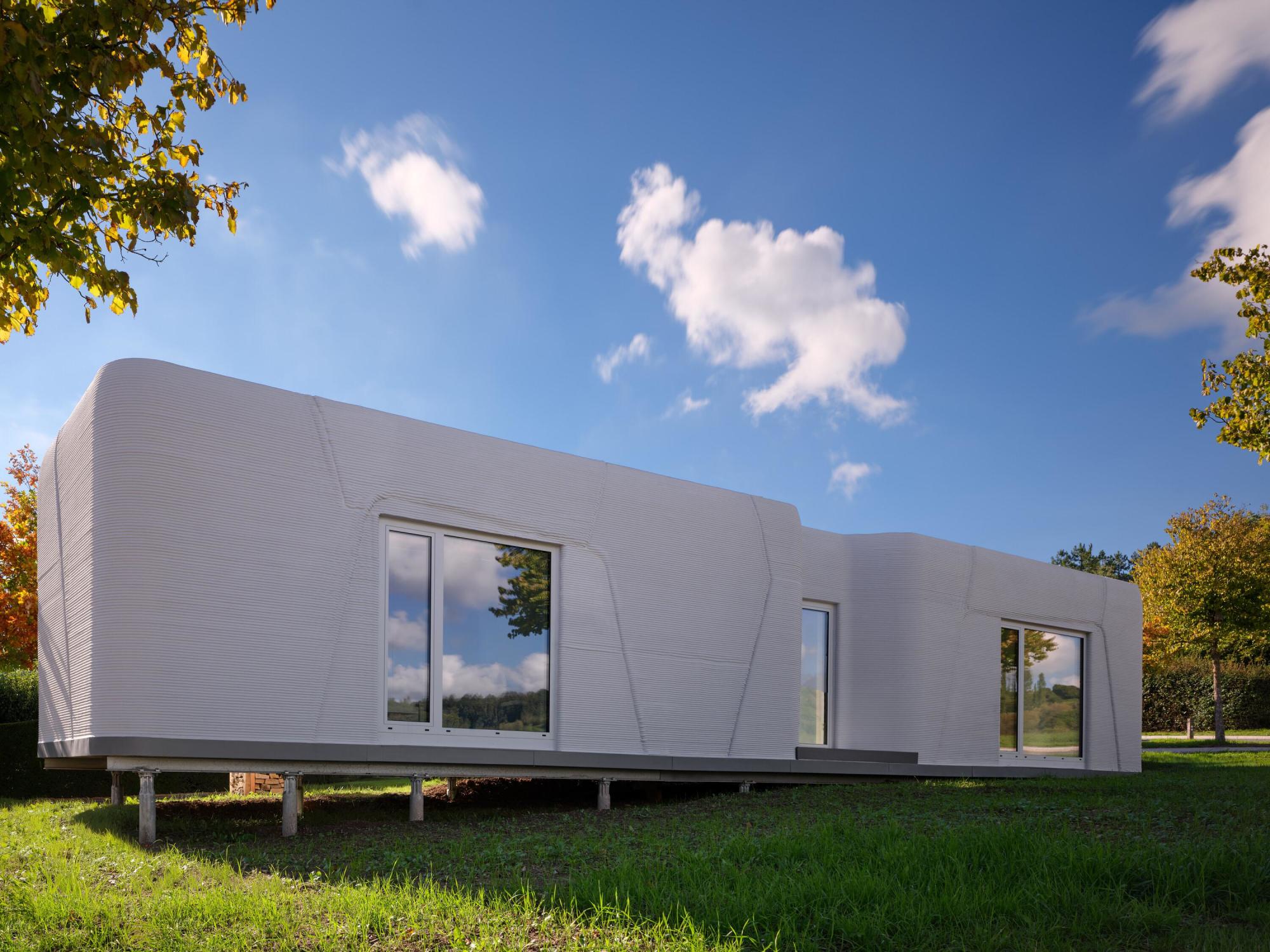
Picture: a photograph of the Tiny House Lux exterior, showing three windows and curved walls. Image Credit: ODA Architects, Coral Architects and boysplaynice
Article written by Ella Tansley | Published 19 November 2025
A tower situated in the Swiss Alps has been recognised as the world’s tallest 3D-printed building. Tor Alva, also known as the White Tower, is an immersive...
Read Full ArticleThe possibilities of large-scale 3D printing have been demonstrated in the construction of El Cosmico, a campground hotel in Marfa, Texas. Hotel designer Liz...
Read Full Article