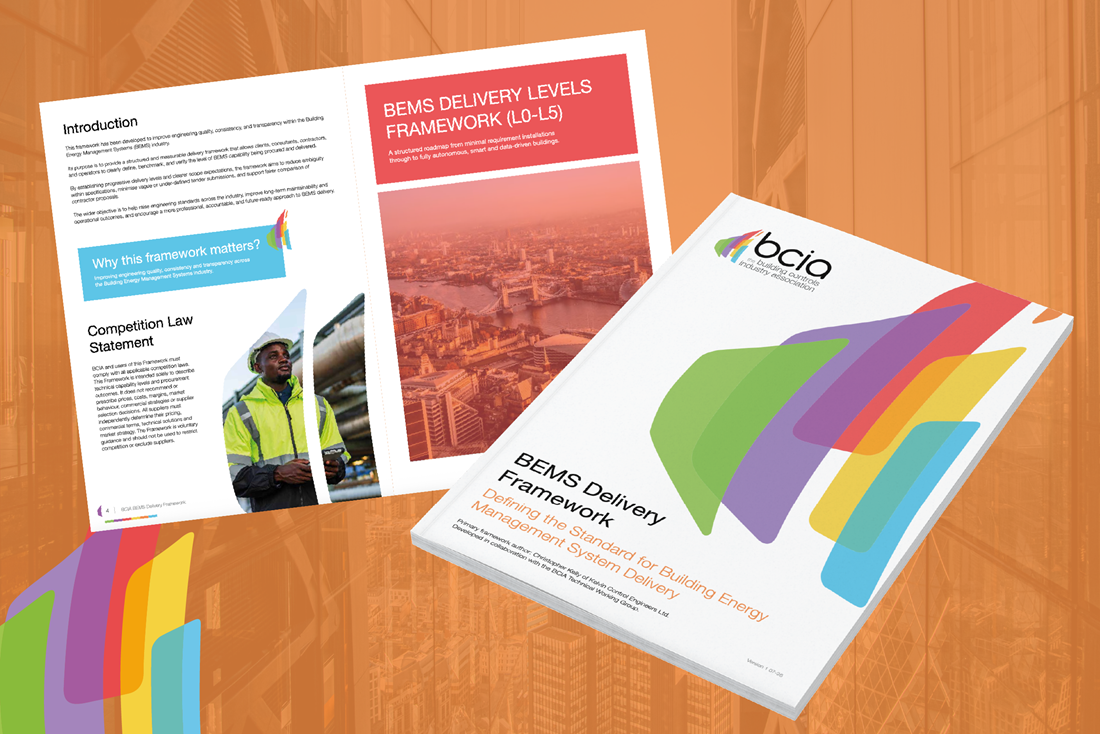
The Building Controls Industry Association (BCIA) has launched a new BEMS Delivery Framework1 designed to tackle inconsistent specification and create a clearer, more consistent approach to the delivery of Building Energy Management Systems (BEMS).
Authored by Christopher Kelly CEng Beng MCIBSE, the framework has been developed and is maintained by the BCIA’s Technical Working Group. It establishes a common language for defining the level of building controls functionality required by a project.
It addresses a longstanding industry challenge: specifications can leave BEMS requirements open to interpretation, resulting in contractors pricing different levels of functionality, difficulties comparing tenders on a like-for-like basis and uncertainty over whether the completed system will meet the client’s operational expectations.
Rather than prescribing particular products, manufacturers or technologies, the framework introduces six clearly defined Delivery Levels, from L0 to L5. These range from basic controls capability through to highly integrated intelligent building functionality, allowing project teams to define the level most appropriate to a building’s operational requirements.
By establishing the required capability before products and technologies are selected, the framework gives clients, consultants, electrical contractors, controls specialists, system integrators and manufacturers a shared understanding of what the completed system is expected to achieve.
The framework is deliberately manufacturer agnostic. Instead of assuming that selecting a particular technology will deliver a particular level of performance, it encourages project teams to establish the required capability first and then determine the most appropriate technical solution.
This clearer definition can support better decision-making throughout the project lifecycle, helping to reduce ambiguity within specifications, improve the consistency and quality of tender submissions and enable fairer comparison between contractor proposals.
It can also improve collaboration between consultants, controls specialists and electrical contractors, support more effective commissioning and system integration, align delivered functionality with client expectations and provide a stronger foundation for ongoing operation, maintenance and future upgrades.
The launch comes as the role of BEMS continues to expand within increasingly connected and data-driven buildings. Building controls now support wider objectives including energy optimisation, system integration, occupant comfort, operational decision-making and long-term building performance.
As the built environment places greater emphasis on measured operational performance, BCIA believes clearer specification and high-quality engineering must increasingly go hand in hand; ensuring sophisticated technology is supported by a clear definition of what it is expected to deliver.
Christopher Kelly CEng BEng MCIBSE, Original/Lead Author of the BEMS Delivery Framework, said: "One of the key objectives was to create something that could be understood and used across the industry. Consultants, controls specialists, electrical contractors, manufacturers and clients may approach a project from different perspectives, but ultimately they all need to be working towards the same outcome."
Kelly continued: "The Delivery Levels provide that common reference point. This isn't about saying every building needs the most advanced solution. It's about defining the right level of functionality for each project and making that requirement clear throughout specification, procurement and delivery."
Ron Purcell, Vice President of the Building Controls Industry Association, said: "Building controls have evolved significantly, but the way we specify them has not always kept pace. Terms such as ‘integrated’ or ‘intelligent’ can mean different things to different people, creating uncertainty from tender stage right through to commissioning."
Purcell continued: “The BEMS Delivery Framework is about removing that ambiguity. It gives the industry a common language for defining what a building actually needs its controls to achieve, so everyone involved can work towards the same outcome from the outset."
Purcell added: "Good building performance starts with being clear about what you want the building to achieve. Technology is an incredibly powerful enabler, but it needs clearly defined objectives behind it."
1. The Building Controls Industry Associations new Building Energy Management Systems Delivery Framework – see here.
Picture: An image of the paperback version of the Building Controls Industry Associations new Building Energy Management Systems Delivery Framework.
Article written by Dave Mapps | Published 28 August 2026
UK Building Controls Market Remains Stable At £840m Despite Slight Q4 Dip
The UK building controls and Building Energy Management Systems (BEMS) market remained broadly stable in 2025, reaching a total value of £840.4 million despite a...
BCIA Welcomes Tougher Commercial Building Energy Standards
The Building Controls Industry Association (BCIA) has welcomed the Government's confirmation that privately rented non-domestic buildings over 1,000 square metres in...
The Warm Homes Plan Must Go Further: Untapped Smart Controls In Non-Domestic Buildings
Jen Vickers, President of the Building Controls Industry Association (BCIA), looks at the Warm Homes Plan and why the government must go further to create a...
The Building Controls Industry Association has published two new technical guides that cover building assessment schemes and regulations for commercial buildings.
The...
BCIA Course to Improve Energy Management Knowledge Launches
With efficient building management taking on increasing importance, the BCIA is encouraging trades personnel to improve their basic knowledge of Building Energy...
In response to the industry-wide shortage of BEMS Controls Engineers, training provider Group Horizon Ltd, in partnership with the Building Controls Industry...
Commercial and public buildings risk being left behind in the UK's transition to net zero despite more than £40bn of funding, investment and policy support...
UK Building Controls Market Revenues Rise to £234.8m In Q1 2026
The UK Building Controls and Building Energy Management Systems (BEMS) market has entered 2026 with renewed momentum, according to the latest Market Information Report...
The Building Controls Industry Association (BCIA) has revealed the winners of the BCIA Awards 2026, celebrating the very best in innovation, achievement and...
The Building Controls Industry Association has named its expert judging panel for the BCIA Awards 2025.
The ceremony will highlight professionals demonstrating...
Rinnai Director, Chris Goggin, looks at how heat pumps being classified as a main solution towards decarbonisation compares to the direction of the UK’s low carbon heating and hot water technology market. Click Image To Read More
Nationwide Air Conditioning Extends David Lloyd Contract
Their 15-year partnership extended to cover Ireland, over 115 clubs and over 10,000 assets. Click Image To Read More
Andy Burnham: A New Direction On NetZero & Possible Future Pathways?
Rinnai Director Chris Goggin evaluates the new potential path of UK emissions reductions under Prime Minister Andy Burnham. Click Image To Read More
Boat Party 2026 Highlights
9 July 2026
400 FM professionals gather on the River Thames. Learn More Here >>
2027 Date announced soon.
Risk Now A Critical Piping System Specification
James Griffiths, Head of Projects at GF Building Flow Solutions, explores how pipe theft forces industry to reconsider long-established specification decisions. Click Image To Read More
Energy Transition Update
Guest Editor, Daniel Lynn, gives examples demonstrating the direction of a collaborative and global energy transition from separate international regions. Click Image To Read More

.gif)
.gif)