




Is Your Cyber Security Winning Or Losing You Contracts?
Facilities management has changed. The buildings you look after now run on networks, from building management systems and access control to CCTV, smart meters and remote...
Read Full Article

The Leading News & Information Service For The Facilities, Workplace & Built Environment Community
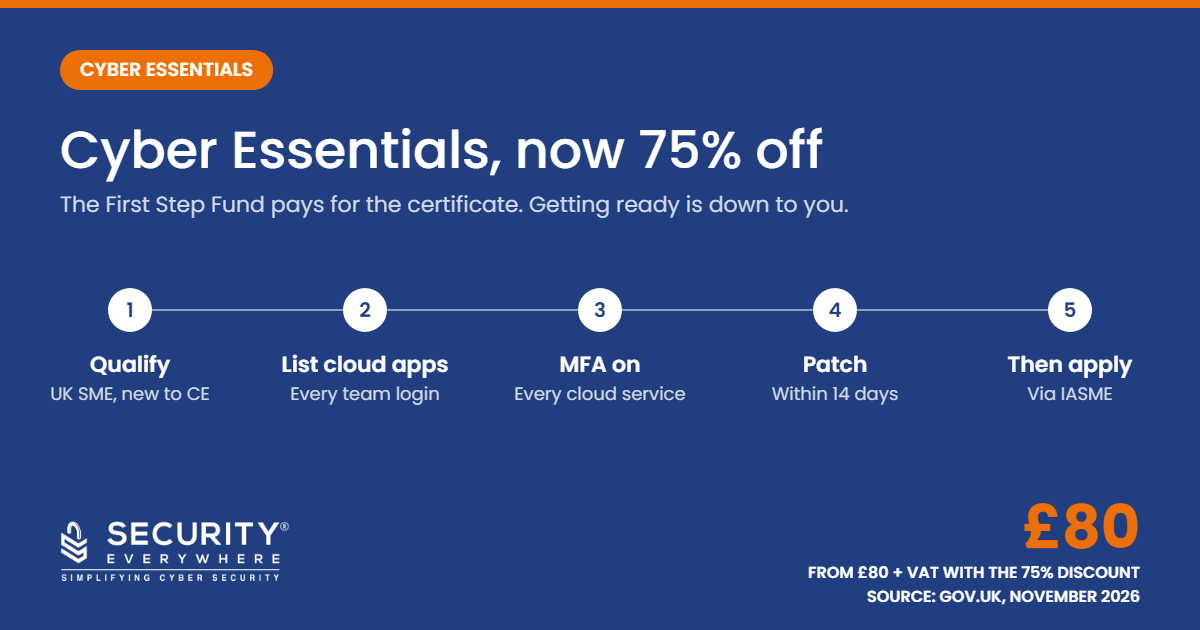
Francis West, CEO of Security Everywhere advises the government will now pay 75% of the cost of your first Cyber Essentials certificate. For an eligible small or medium business, that brings it down to between £80 and £125 plus VAT, but the money is first come, first served and runs until March 2027 at the latest.
That matters because Cyber Essentials is not just a certificate on the wall. It is proof that wins you work: bigger clients, government contracts and better insurance terms. This post covers how it pays for itself, what the new First Step Fund covers, who qualifies, how to apply, and the one thing the discount does not pay for.
What The Government Announced
On 3 November 2026 the government announced two funding schemes for Cyber Essentials1. The details are on the Cyber Essentials funding package page on gov.uk2.
The First Step Fund.
75% off a first Cyber Essentials certificate for eligible UK micro, small and medium businesses. The pot is £2.4m, which the government estimates will help around 6,000 businesses.
The Cyber Essentials for Suppliers grant.
100% of the cost of a first certificate, plus access to a Cyber Advisor, for selected SME suppliers to organisations that have signed the government’s Cyber Resilience Pledge. Up to £7m is available until March 2029.
Most of the businesses we speak to will be looking at the First Step Fund, so that is what the rest of this post covers.
How Cyber Essentials Makes You Money
Most business owners see cyber security as a cost. The ones who grow see certification as a sales tool. Here is why.
Your customers can see you take security seriously.
A recognised certificate answers the question before they ask it, and it sets you apart from competitors who cannot show the same proof.
Bigger clients and government buyers ask for it.
Government departments and NHS bodies ask for Cyber Essentials on contracts that involve personal data. More and more of the large companies our clients supply now insist on it before they will add you to their supplier list. No certificate, no contract.
Insurers look for it.
Insurers ask about the same controls at renewal, such as MFA, backups and patching. According to the government announcement, organisations with Cyber Essentials and a turnover under £20m also get up to £25,000 of cyber liability insurance.
We have seen how much this can be worth. The owner of a medical company we work with lost a contract worth £1 million a year with a major UK insurer, despite a strong personal relationship with the client. The insurer needed proof of certification, in his case ISO 27001. We helped him get certified, and he won the contract back.
It also protects the money you already have. The same government announcement quotes an estimate that a significant cyber attack on a UK business costs around £195,000 on average. The government says that figure is indicative, because it is built mainly from US data. Compare that with a certificate that now costs £80 to £125 plus VAT.
Who Qualifies
Based on the gov.uk announcement, you are eligible for the First Step Fund if:
you are a UK micro, small or medium-sized business, and
you have not held a Cyber Essentials certificate in the last four years.
If you already renew every year, this one is not for you. If you let it lapse a while ago, it may well be.
How To Apply
Applications go through IASME, the Cyber Essentials partner, at firststep.iasme.co.uk. The offer opened on 3 November 2026 and runs until March 2027 or until the money runs out, whichever comes first. With around 6,000 places, we would not wait until the spring.
The catch: the discount pays for the certificate, not for passing
This is the part nobody puts in the headline. The fund reduces the fee for the assessment. It does not make your systems ready for it, and the bar went up this year.
Since 27 April 2026, two things are automatic fails:
any cloud service that offers multi-factor authentication (MFA) but does not have it switched on, and
a high or critical security update left unpatched for more than 14 days.
That covers every cloud tool your team logs in to, not just Microsoft 365. The forgotten file sharing account, the old CRM login, the AI tool someone signed up to on their own. If one of them has MFA available and switched off, you fail.
So the smart order is: get ready, then apply. Use the discount on an assessment you will pass first time.
What To Do
1. Check you qualify.
UK SME, and no Cyber Essentials in the last four years.
2. List every cloud service your team uses.
Then check MFA is switched on for each one.
3. Check your updates.
Laptops, phones, servers, routers and firewalls. Anything high or critical older than 14 days needs fixing now.
4. Take a quick readiness check.
A free Cyber Essentials Readiness Check3 takes about 3 minutes and shows you which of the five controls would trip you up.
5. Apply for the fund.
Once you are confident you will pass.
Not sure whether you need Cyber Essentials or Cyber Essentials Plus? Our guide Cyber Essentials vs Cyber Essentials Plus4 explains the difference. Some businesses do not need Plus at all.
1. Two funding schemes for Cyber Essentials – see here.
2. Cyber Essentials Funding Package – see here.
3. Free Cyber Essentials Readiness Check – see here.
4. Cyber Essentials vs Cyber Essentials Plus Guide – see here.
Picture: An infographic outlining the five steps for UK SMEs to get a 75% discount on Cyber Essentials certification, lowering the starting price to £80.
Article written by Francis West | Published 19 November 2026
Facilities management has changed. The buildings you look after now run on networks, from building management systems and access control to CCTV, smart meters and remote...
Read Full ArticleFacilities Management businesses invest heavily in keeping buildings running smoothly, yet one of the biggest cyber risks often sits outside their control, their...
Read Full ArticleFrancis West, CEO of Security Everywhere, warns that ‘Account Takeover’ is one of the most common ways cyber-attacks begin. It rarely starts with anything...
Read Full ArticleTerry Keller, Chief Technology Officer at MRI Software, looks at why cybersecurity is increasingly becoming a challenge for facilities managers, rather than something...
Read Full ArticleFacilities managers are being warned about the hidden cyber security risks inside their building systems because of new technologies which are moving at a rapid...
Read Full ArticleFrancis West warns that in facilities management, your phone is your office. Work orders, contractor updates, client sign offs, building access. It all runs through your...
Read Full ArticleLeeds College of Building (LCB) is one of 18 colleges in Yorkshire and the Humber set to benefit from government funding for essential estates and building...
Read Full ArticleSecurity Everywhere warns of the rapidly growing cyber-enabled crime of Payment Fraud and advises how to protect your company. When cyber risk is discussed...
Read Full ArticleOne in four digital systems used by central government are outdated, costing the public sector £45 billion in productivity savings. This figure equates to paying...
Read Full ArticleIn Part 3 of our cyber security Q&A, Sheldon Reynolds talks us through the danger of reusing passwords and what happens on the dark web. According to data...
Read Full Article