




COVID-19 Working From Home Guidance – What’s the Latest?
Employees in England are no longer being asked to work from home, as the government removes Plan B rules. But is this change as simple as encouraging a mass return to the...
Read Full Article

The Leading News & Information Service For The Facilities, Workplace & Built Environment Community
Just Eat for Business, an office food delivery marketplace, has revealed new research1 into how hybrid working is reshaping the informal moments that once shaped workplace culture – the everyday ‘watercooler chat’ that happened simply because colleagues were together in the same room.
The traditional watercooler was never really about the water - it was about the unplanned conversations around it, the spontaneous questions and the moments that unfolded naturally between meetings. As hybrid working reshapes the traditional office routine, the research reveals those moments are becoming harder to recreate, and shared meals are stepping in to fill the gap.
Spontaneous, informal conversation is proving the hardest thing to replace under hybrid working. What’s been hardest to replicate in hybrid working isn’t meetings or processes - it’s the informal, unplanned conversations that once defined office life. When asked what their team had lost most since shifting to hybrid, managers were most likely to point to spontaneous, casual conversation (44%), more than double the next highest factor, the ability to notice when colleagues may be struggling (20%).
Employees echo the same challenge, with 58% saying they hesitate to ask questions or raise issues remotely because it doesn’t feel as natural over chat.
That’s not to say communication has broken down altogether with 84% of managers saying their team’s communication has at least maintained since going hybrid. But the ability to simply hold a conversation isn’t the same as recreating the spontaneous moments that used to happen without anyone scheduling them. Among managers, this ease of communication varies by age, with 71% of managers aged 25-34 saying communication is easier since going hybrid, more than double the 26% reported among managers aged 55-64. The same pattern holds by generation too, with 52% of Millennial managers saying communication is easier, compared with 40% of Gen X managers and just 18% of Boomer managers.
Shared Meals Become New Workplace Ritual
As the traditional office routine changes, food and shared spaces are taking on a greater role in creating opportunities for informal connection.
Among employees who experienced both the pre-COVID office and today's hybrid workplace, 30% identify the kitchen – rather than a formally organised social event – as their top spot for casual workplace chit-chat. It’s a sign that workplace connection is increasingly happening organically, in shared communal spaces, rather than through structured social occasions.
For employees who started their careers in 2020 or later, however, the lunch areas inside the office have taken the lead. Four in ten (40%) say lunch areas inside the office are their number one source of casual chit-chat, almost twice the 21% recorded among those who started their careers before 2020.
The social value of eating together is clear across the wider workforce, too. 86% of hybrid workers believe eating meals or taking breaks with colleagues helps build stronger workplace relationships, while team socials (38%) and team lunches (27%) are considered the most effective ways to build strong friendships and relationships at work, ahead of in-person meetings (20%) and instant messaging (6%). Yet the opportunity isn’t always there: one in four hybrid workers say they rarely get the chane to take breaks with colleagues at all.
Gen Z And Younger Workers Create New Ways To Connect At Work
For employees who started their careers after 2020, the office has never been a five-day-a-week experience. Rather than disengaging from workplace culture, this group appears to be shaping new rituals around how they connect.
Nearly half (49%) say they eat with colleagues often or always, compared with 30% of those who started before 2020. They are also more likely to feel connected to colleagues overall (84% vs 74% of hybrid workers), and far less likely to report having no casual chit chat at all (3% vs 10%).
Shared meals are central to this shift. A strong majority (91%) of early-career employees say eating or taking breaks with colleagues helps build stronger workplace relationships. For many, food is even a reason to come into the office: 47% say they have gone in specifically for a free team breakfast or lunch.
At the same time, some traditional office behaviours are fading. Just 50% would now walk over to a colleague’s desk to ask a quick question, compared with 64% of those who experienced pre-COVID office life.
Bringing People Together Matters More Than Ever
The research also highlights the benefits employees and managers associate with hybrid working. For managers, 53% cite better work-life balance leading to happier teams as one of the biggest benefits, while 21% value the ability to collaborate flexibly across locations and time zones, and 15% point to more structured, focused meetings as a key gain. But as the office becomes somewhere people come together with greater purpose, rather than simply the place they work every day, the moments that happen between meetings matter more than ever.
Shared meals offer one simple way to create those moments. Eating together gives colleagues a natural reason to step away from their screens, spend time together and have conversations that might never make it onto a calendar invite. Perhaps, then, the watercooler hasn't disappeared. Its role has simply evolved and increasingly, that moment of connection might be happening around the lunch table instead.
Additional key findings from the survey of UK office workers include:
58% of hybrid workers say they hold back from asking a question or raising an issue remotely because it is harder to do over chat.
34% of managers say their teams eat lunch together less often on office days than they did before COVID-19.
23% of Millennial managers say they make more effort to eat together as a team now that office days are limited, compared with 6% of Gen X managers.
81% of employees who experienced both pre-COVID office culture and today's hybrid workplace believe shared meals help build stronger workplace relationships.
Tom Baxter, Managing Director at Just Eat for Business, said: “Hybrid working has changed the way we work, but it hasn't changed the importance of having good relationships with the people we work alongside.”
Baxter continued: “Some things are easier than ever. We can collaborate across locations, communicate quickly and have much more flexibility in how we work. But there are other moments that don't happen as naturally when you're not sitting alongside your colleagues every day.”
Baxter highlighted: “That's where food can play an interesting role. Sitting down for lunch gives people a reason to step away from their screens, spend time together and have the kind of conversations that are difficult to schedule into a diary.”
Dr Audrey Tang, Chartered Psychologist, said: “In 2002, Patrick Lencioni identified the five dysfunctions of a team, with a lack of trust at its foundation. If working in silos becomes the norm, with people unwilling to share ideas or ask for help, performance can only ever be as good as each individual, and the whole never gets the chance to be greater than the sum of its parts.”
Dr Tang continued: “The experience of COVID-19 may also have left a lingering hesitancy, with greater concern for others’ welfare seeing people hold back from ‘popping over’ to a colleague for support. But more can still be done to encourage informal interactions, and to remind people that help is more readily given when it’s asked for, rather than put into a Teams chat.”
1. The New Watercooler Report by Just Eat for Business – see here.
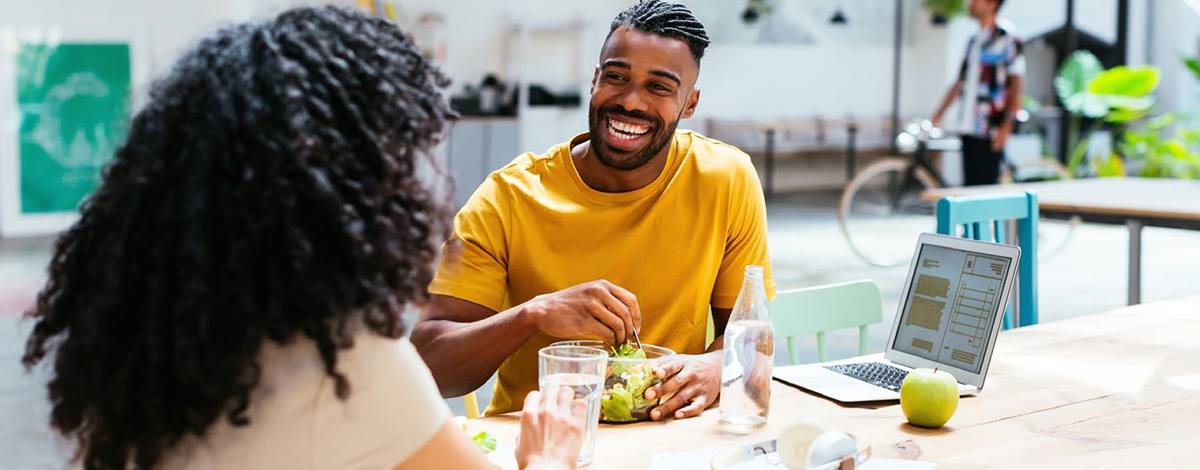
Picture: A smiling man sits at a table with a laptop, salad, and water, conversing with a woman facing away from the camera in a modern workspace.
Article written by Dave Mapps | Published 30 October 2026
Employees in England are no longer being asked to work from home, as the government removes Plan B rules. But is this change as simple as encouraging a mass return to the...
Read Full ArticleSimon Barnes, Vice President Sales and Marketing, ABM UK & Ireland, highlights that contrary to assumptions, Gen Z spends the most days in the office seeking...
Read Full ArticleTom Baxter, Managing Director at Just Eat for Business, discusses managing fluctuating summer occupancy is FM's top challenge, but thoughtful workplace food fosters...
Read Full ArticleNew analysis from Colliers, covering more than 200 global markets, shows how artificial intelligence, hybrid working and intensifying competition for talent are...
Read Full ArticleTom Baxter, Managing Director at Just Eat for Business, explores how facilities leaders can use food more strategically to support their office strategy, based on...
Read Full ArticleA guide to help facilities managers create workspaces for the hybrid working generation has been published by the British Council for Offices. The BCO’s flagship...
Read Full ArticleKarl Breeze from Matrix Booking discusses how to strike the right balance between in-office and remote work in a business. Karl joined Matrix Booking as CEO in August...
Read Full ArticleThe International WELL Building Institute has introduced a new building health rating specifically for co-working spaces. The WELL Co-working Rating, administered by...
Read Full ArticleThe government is proposing to consult on the “right to switch off” for employees. This would give employees the right to digitally disconnect from...
Read Full ArticleThe British Council for Offices has unveiled its new research agenda, with a vision for the office as a sustainable part of the built environment. The briefing note...
Read Full Article