.gif)

.gif)

PTSG Launches New Siphonic Health Check Tool
NSS, part of PTSG, has launched a free online Siphonic Health Check tool to help building owners, facilities managers and property professionals understand whether...
Read Full Article.png)

The Leading News & Information Service For The Facilities, Workplace & Built Environment Community
Hannah McNamee, Service Sales Manager at Capcon Engineering, discusses siphonic systems and how they can reduce risk, support ESG goals and help FMs run a more water-smart, cost-effective estate.
No-one who endured the seemingly constant and record-breaking downpours during January and February will need reminding about rising rainfall levels and longer-lasting storms. Facilities managers will also have been casting anxious glances skywards, as severe weather brings a greater risk of drainage incidents that could affect building interiors and disrupt operations.
With so many parts of a site to manage, roofs can sometimes be a case of ‘out of sight, out of mind’ for facilities managers. But in our experience, older roof drainage systems that were designed 10 or 15 years ago are not equipped to handle the capacity and intensity of rainfall we see now.
According to the State of the UK Climate Report for 20241, the UK’s climate has become steadily wetter since the 1980s. This is due to an increase in the winter rainfall from October to March. Climate modelling shows rainfall intensity has increased significantly in recent years, while storms are lasting longer and occurring more frequently.
To put it in simple terms, rain is hitting roofs harder than it used to, which leads to greater volumes of rainwater, as measured in litres per second, passing through drainage pipes that might be just 100ml in diameter.
This is leading to higher amounts of localised flooding and roof ponding, with fewer extended dry spells in between rainfall that allow water to disperse or evaporate.
Undersized drainage systems that haven’t been properly maintained over time are at risk of blockages that could lead to water leaking from roofs into ceilings and walls, causing structural damage and, in extreme cases, partial roof collapse: a scenario no FM wants to face.
Amid rising utilities bills and tightening budgets, and with one eye on tightening regulatory standards, facilities managers need cost-effective drainage solutions that are easy to maintain and help them to stay compliant. Siphonic drainage systems can make a meaningful, measurable difference when used alongside, or as a replacement for gravity-based systems. As extreme rainfall events increase across the globe, siphonic systems can reduce risk, support ESG goals and help FMs run a more water-smart, cost-effective estate.
Savings vary per building but they are significant. From projects that Capcon Engineering has worked on, the range of cost reduction is typically between 20% and 45% compared to traditional rainwater management systems. A regularly maintained siphonic system causes fewer issues, which leads to lower cost because it prevents pipework from needing to be replaced.
There is also new guidance on how frequently the maintenance should be carried out. New British Standards (BS) on siphonic and gravity drainage introduced in 2025 make a specific reference to how often maintenance should take place to ensure the systems stay under warranty.
BS EN 12056-3:2000 and BS 8490:2025 state: “Gutters, rainwater pipes, outlets and leafguards should be inspected and thoroughly cleaned not less than four times per year, or more often if the building is in or near an industrial area, coastal area, shopping centre, is near to trees or fast-food outlets or might be subjected to extremes of temperature. The frequency of inspection should be based upon local experience. Defects should be remedied as soon as possible after being noted.”
Unlike traditional gravity systems that rely on large diameters and continuous falls to move water off the roof and into the ground, siphonic drainage uses smaller-diameter, full-bore pipework running level, creating a siphon effect that pulls water efficiently from the roof.
From a facilities and ESG perspective, this brings several benefits: on the construction side, siphonic drainage typically requires less raw materials like pipes and fittings, which reduces the level of embedded carbon compared to traditional gravity drainage. There’s less need for excavation, which helps to keep costs under control. Routing water to storage tanks or discharge points is also more efficient than with older systems.
In many cases, siphonic systems can deliver significant carbon savings across a project. For FMs taking over a building, those embodied savings are already included, but they still matter for whole‑life carbon reporting, particularly on new builds and major refurbishments.
Another benefit of siphonic drainage is in enabling rainwater harvesting and reuse. Because the system doesn’t depend on a natural fall in the ground, water can be directed more flexibly to where it’s needed, such as storage tanks. This makes it easier for roof drainage to be integrated cleanly with rainwater harvesting systems, for uses such as irrigation, process cooling or non‑potable domestic applications. For FMs being tasked with ESG reporting, this ticks many boxes. It’s a smart way to turn rainwater from a risk to be managed into a resource to be used.
Siphonic drainage systems also address another key concern for FMs: unforeseen events. A well‑designed siphonic system, together with a structured maintenance schedule, takes unpredictability off the table by lowering the risk of blocked outlets or damaged components that could lead to leaks, damage, and downtime.
1. State of the UK Climate Report for 2024 – see here.
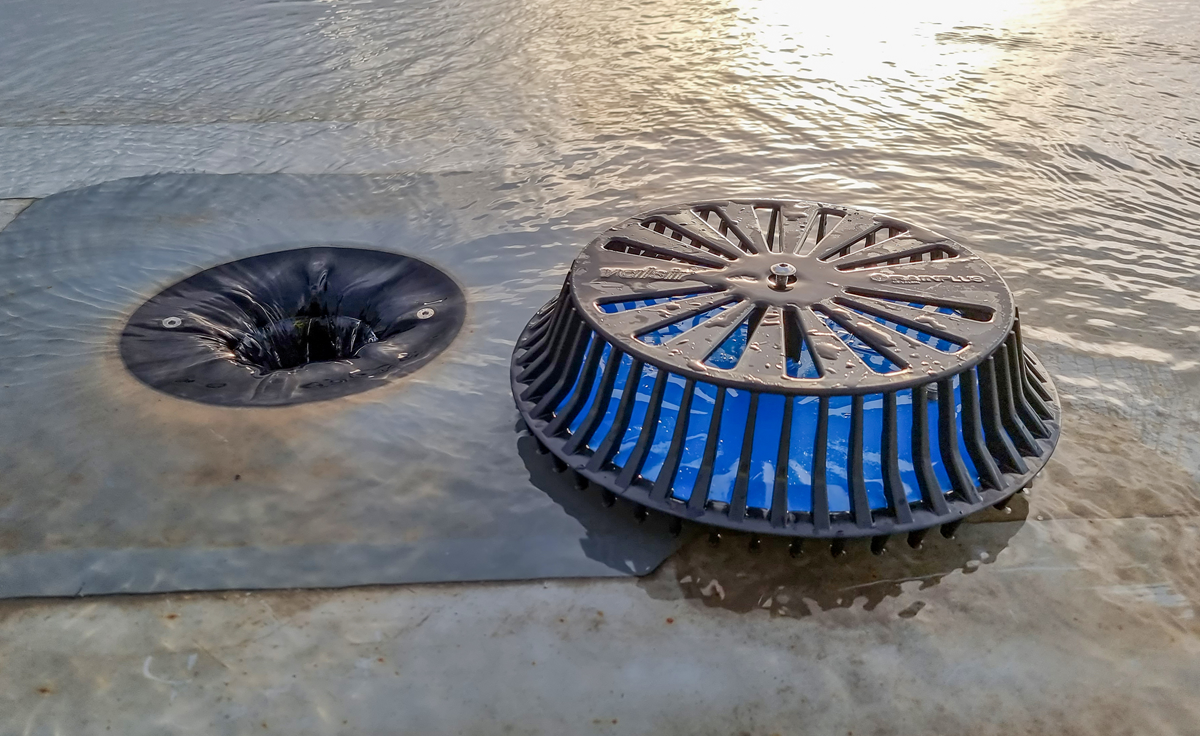
Picture: An image of an opened siphonic outlet
Article written by Hannah McNamee | Published 04 June 2026
NSS, part of PTSG, has launched a free online Siphonic Health Check tool to help building owners, facilities managers and property professionals understand whether...
Read Full ArticleThe UK’s drainage infrastructure is under mounting pressure from age, demand and neglect. Much of the network is still rooted in Victorian-era design and is now...
Read Full ArticleTechnical services provider Mecsia has completed its acquisition of The Drain Group, a drainage specialist operating across the West Midlands. The Drain Group will...
Read Full ArticleLondon Drainage Facilities has acquired Lewes-based drainage and plumbing services provider BlockBusters. This will allow London Drainage Facilities to expand its...
Read Full ArticleJet Through has won its bid to provide drainage services to one of the UK’s largest pub and brewery chains, Greene King. The three-year contract will see...
Read Full ArticleTechnical FM provider Thermatic has acquired PDS Drainage Solutions. PDS’ position in the commercial drainage market in the UK will aid Thermatic’s’...
Read Full Article

.jpg)