.gif)
.gif)


BESA Backs Regulator’s Warning To Main Contractors
The Building Engineering Services Association (BESA) says it strongly supports a stark warning from the Building Safety Regulator that main contractors must...
Read Full Article.png)

The Leading News & Information Service For The Facilities, Workplace & Built Environment Community
Kiwa has launched a new third-party certification scheme for organisations delivering the service, maintenance, and repair of smoke control systems, providing independent verification of competence at a time of increased regulatory scrutiny across the built environment.
Kiwa is an independent, impartial global provider of Testing, Inspection and Certification. They offer laboratory, (statutory) inspection, auditing and assurance activities, supported and strengthened by (strictly separated) training, consultancy, and data services.
The IFC Certification unit of Kiwa has developed the new SMR 01 certification to assess the competence of businesses responsible for maintaining smoke control and smoke ventilation systems in all buildings, particularly high rise and higher risk. The scheme is designed to support clients, duty holders and Responsible Persons seeking assurance that maintenance work is being carried out to recognised industry standards.
Its launch follows significant changes to the building safety landscape, including the Building Safety Act and Fire Safety Act, which have strengthened responsibilities for the management of fire safety systems in higher-risk buildings. These reforms place greater emphasis on demonstrating competence and verifying that those carrying out safety-critical work are appropriately qualified. Third-party audits can support this.
SMR 01 provides ongoing independent assessments of certified organisations, combining a business management audit with site inspections of service engineers carrying out service, repair and maintenance work. The number of engineer assessments is proportionate to the size of the workforce, enabling ongoing verification of competence in live working environments.
The certification scheme has been developed in line with guidance from the Smoke Control Association and relevant British Standards. It covers four key categories of smoke control systems:
• Single-zone ventilation
• Multi-zone natural ventilation
• Multi-zone mechanical ventilation
• Pressure differential systems, including stairwell pressurisation systems
By providing independent verification of competence, Kiwa says the scheme will help support improved standards across the smoke control sector while offering reassurance to building owners, facilities managers, residents, and other stakeholders responsible for fire safety compliance.
Olly Lucas, Scheme Manager for SMR 01 Certification at Kiwa, said: "The introduction of the IFC Certification SMR 01 scheme provides a structured, independently audited certification programme designed specifically for organisations responsible for maintaining smoke control and smoke ventilation systems.”
Lucas continued: "Following the Grenfell Tower tragedy, the industry has seen an increased focus on competence, accountability and third-party assurance. Alongside the Building Safety Act 2022 and Fire Safety Act 2021, there is now greater emphasis on ensuring that life safety systems are maintained correctly throughout a building's lifecycle.
Lucas added: "SMR 01 allows organisations to demonstrate that both their management systems and on-site maintenance activities have been independently assessed against recognised industry standards. It also provides building owners and property managers with greater confidence that smoke control systems are being maintained by competent providers."
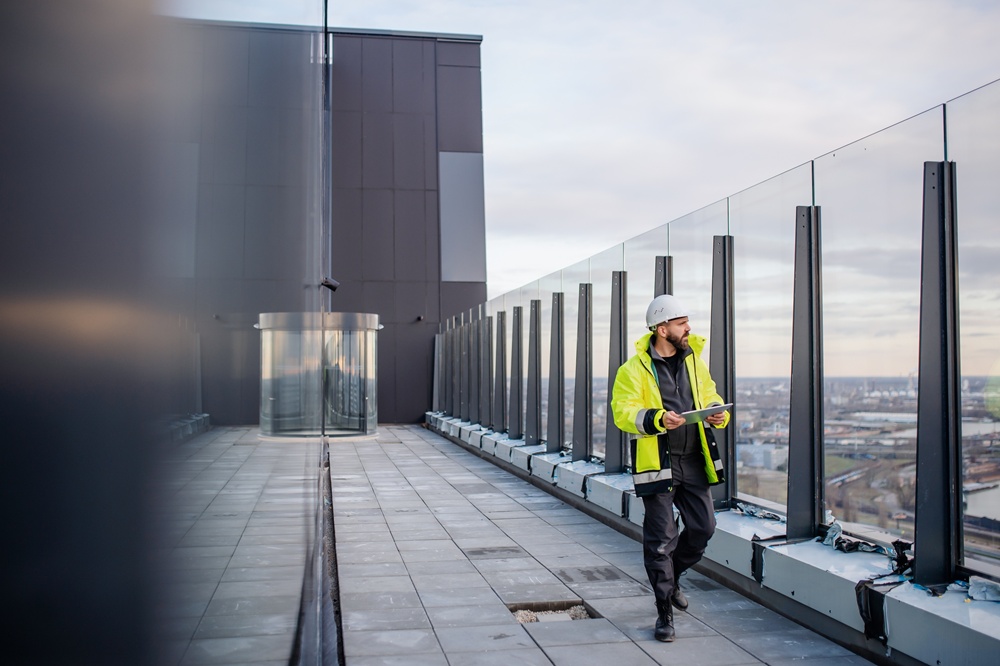
Picture: An image of an inspector, wearing a hard hat and high-vis, checking to roof of a high-rise building.
Article written by Dave Mapps | Published 18 August 2026
The Building Engineering Services Association (BESA) says it strongly supports a stark warning from the Building Safety Regulator that main contractors must...
Read Full ArticleFDIS Ltd, the owner of the Fire Door Inspection Scheme (FDIS), has become the first organisation in the UK to be awarded UKAS accreditation for the certification of fire...
Read Full ArticleSFG20, the industry standard for FMs and building maintenance teams, has interviewed Dame Judith Hackitt to discuss the Building Safety Act and building safety...
Read Full ArticleAdhering to new legislation, understaffing, and technological adoption barriers are some of the FM industry’s biggest challenges, according to a new...
Read Full ArticleDeputy Prime Minister Angela Rayner has responded to the Grenfell Tower Inquiry’s final report. The government has accepted the inquiry's findings and plans to...
Read Full ArticleClients are still pressuring contractors to prioritise cost and speed over safety, according to the Building Engineering Services Association. In a series of...
Read Full ArticleAlex Minett from Veriforce CHAS explores the role of competence in the new Building Safety Act 2022. Alex has extensive knowledge of construction best...
Read Full ArticleBuilding control professionals in England have received a 13-week extension to allow them more time to complete competence assessments. The Director of Building Safety...
Read Full ArticleThe 6 April 2024 deadline is approaching, marking the end of the transitional period for building control applications and a new regime which has implications for those...
Read Full ArticleDaniel Foryszewski from MRI Software explores how residential building operators can leverage data and technology to comply with safety standards and adopt new...
Read Full Article