.gif)

.gif)

The Classification Game: Why ‘Extra Care’ Isn’t ‘Care’
Iain Cox, Chairman of the Business Sprinkler Alliance (BSA), continues to press the case for a fundamental rethink of how fire safety regulations treat housing for...
Read Full Article

The Leading News & Information Service For The Facilities, Workplace & Built Environment Community
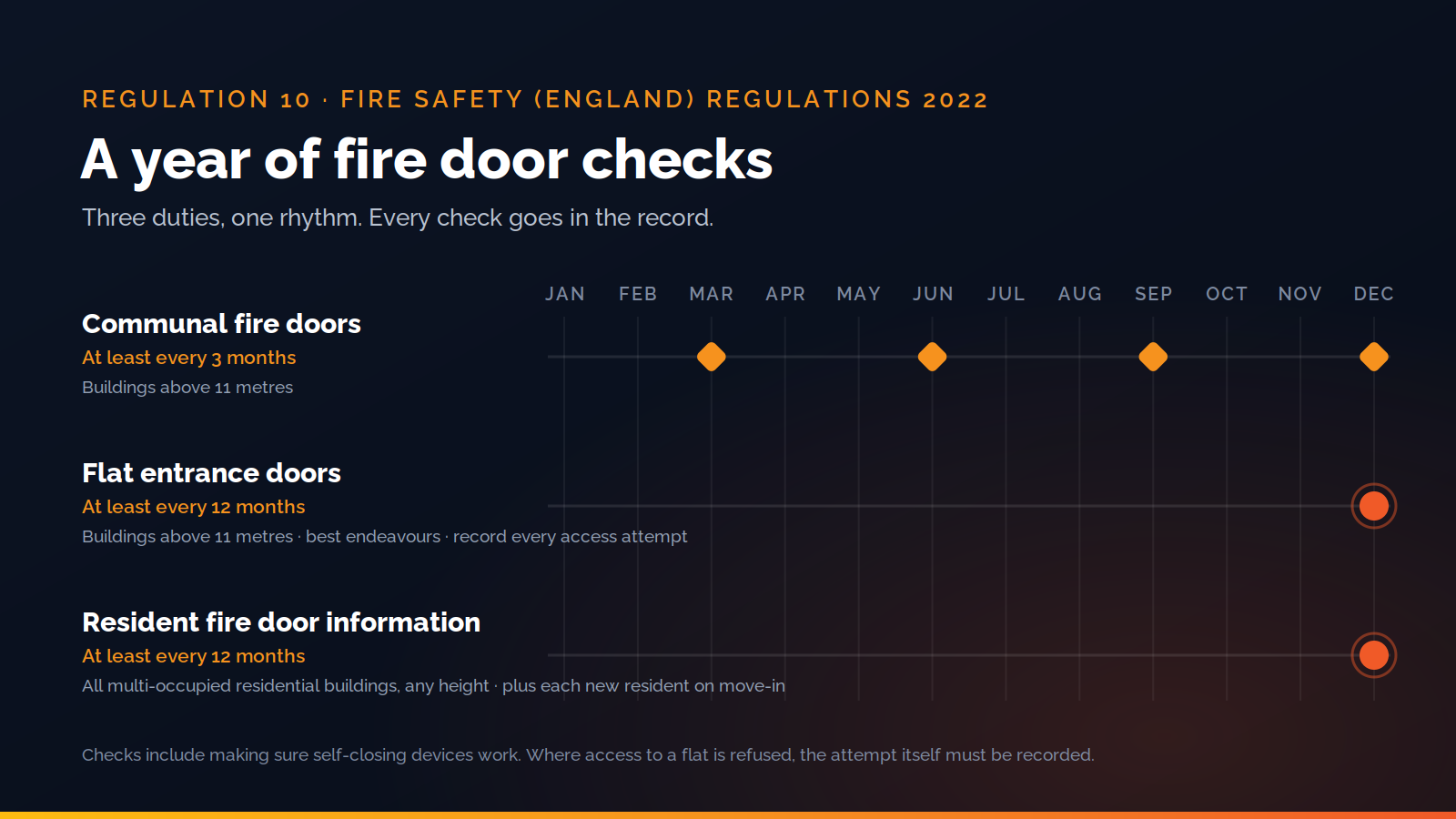
Kemble Nagan, Managing Director at DoorTRACE, notes that January marked three years since Regulation 10 of the Fire Safety (England) Regulations 2022 came into force. For anyone responsible for a residential building above 11 metres, it set a rhythm that never lets up: communal fire doors checked at least every three months, flat entrance doors at least once a year, and a record kept of the lot.
Three years in, the pattern is clear. The checking itself is rarely what catches teams out. The volume is, and so is proving the checks happened.
The duties sit with the responsible person under the Fire Safety Order; in practice the work lands with the facilities team. In buildings above 11 metres, communal fire doors need a check at least every quarter. Flat entrance doors opening onto common parts need one at least annually, on a best endeavours basis: residents are not always in, so the law asks you to try, keep trying, and record the attempts.
One duty reaches further than most realise. In any building with two or more homes and shared escape routes, whatever its height, residents must be told to keep fire doors shut, not to tamper with self-closers, and to report faults straight away. New residents get this on moving in; everyone gets it again each year.
Simpler Than People Think
The routine check is not a specialist job, which surprises many teams. The government's fact sheet says a specialist should not be necessary: the responsible person can carry out these checks themselves. It expects a careful look, not a technical examination. Does the self-closer shut the door fully into the frame? Are there obvious gaps, visible damage or altered glazing? Are seals and hinges fitted correctly?
Anything worrying gets escalated to a specialist; the deeper assessment of fire resistance belongs with the fire risk assessment. That distinction keeps the quarterly workload in-house, brisk and repeatable.
What the Data Shows
FDIS inspection figures for 2025, reported in March, found 72% of fire doors inspected did not meet the required standard. An earlier dataset of more than 100,000 inspections told the same story: 75% failed, led by excessive gaps (77%), care and maintenance issues (54%) and smoke sealing problems (37%).
The encouraging figure sits alongside: around 70% of non-compliant doors needed only minor remedial work. Most problems are small, cheap and fixable, provided somebody spots them and follows through.
Where Teams Sink
Where do teams struggle? Scale, mostly. Forty doors a building, checked quarterly, across a portfolio adds up to thousands of checks a year, each needing a date, a result and a follow-up. Paper and spreadsheets cope until the first gap appears: a missed block, a defect logged but never closed out, an access attempt nobody wrote down. When the fire and rescue authority asks what you did, the work only counts if the record exists.
A Workable Routine
The teams coping best share a few habits. They schedule the checks like any other planned maintenance. They use one consistent checklist built on the government's own list. They record failed access attempts as carefully as completed checks, because best endeavours is proven by the attempts. And they keep every check, defect and repair against the individual door in one place, so the history is there when anyone asks. That last habit is the reason we built DoorTRACE, and it is the difference between compliance you can show and compliance you have to reconstruct.
The Rules Keep Moving
The framework has not stood still. In August 2025 the government revised its fire door guidance to calm an over-reaction: the absence of intumescent strips, smoke seals or certification does not by itself mean a door is unfit for purpose. In March this year BS 8214:2026 replaced the 2016 edition, extending the code of practice beyond timber to fire door assemblies in every material. Neither change alters the quarterly rhythm. Both reward teams whose records are good enough to show what they have, and what they did about it.
Three years on, Regulation 10 has done what it set out to do: fire door condition is now a routine, evidenced part of building management rather than an afterthought. Teams finding it heavy are rarely short of diligence; they are short of a system. Fix that, and the rhythm looks after itself.
Picture: An infographic showing Regulation 10 of the Fire Safety (England) Regulations 2022 requirements.
Article written by Kemble Nagan | Published 11 August 2026
Iain Cox, Chairman of the Business Sprinkler Alliance (BSA), continues to press the case for a fundamental rethink of how fire safety regulations treat housing for...
Read Full ArticleIain Banks of Allegion UK provides detailed commentary on the functional hardware behind fire doors, exploring how each component plays a vital role in protecting people,...
Read Full ArticleAs commercial buildings continue to adapt through refurbishments, changing occupancy levels and evolving workplace practices, fire safety planning also needs to evolve....
Read Full ArticleA Sky News investigation has revealed that a manager at Clarion Housing encouraged an employee to falsify a fire safety notice in one of the housing association’s...
Read Full ArticleNew research to mark Fire Door Safety Week reveals that a combination of a surge in lithium-ion battery fires from e-bikes and e-scooters, along with poor fire door...
Read Full ArticleA construction firm has been fined for repeatedly ignoring fire safety precautions during the conversion of a Preston warehouse into residential apartments. Lancashire...
Read Full ArticleThe Fire Brigades Union and other groups have written to Sadiq Khan and Bromley Council leader Colin Smith, raising concerns over plans for a 17.7-metre-high development...
Read Full ArticleKirk Smith from Allegion UK reviews the attitudes towards passive fire protection in public-facing buildings and why being more proactive with fire door safety can help...
Read Full ArticleEmergency services have attended the scene of a fire at a high-rise apartment complex in Valencia, Spain The fire occurred on Thursday 22 February at a...
Read Full ArticleData from UK fire and rescue authorities has identified the number of electrical fire-related callouts to businesses. Using statistics from 32 fire and...
Read Full Article