
.gif)
.gif)
BRE Announces Winners Of BREEAM Awards 2026
BRE has revealed the winners of its annual BREEAM Awards 2026 - a celebration of the projects, organisations and people leading the way in sustainable building design,...
Read Full Article

The Leading News & Information Service For The Facilities, Workplace & Built Environment Community
The Royal Institution (Ri) is on track to achieve a remarkable 42% reduction in carbon emissions at its Grade I listed Georgian building – surpassing its original target of 35% – thanks to a £4.35 million grant from the Mayor of London.
A centre for scientific discovery for over 225 years, with sections dating from 1705, the Royal Institution's home on Albemarle Street has undergone transformative works to move from a commercial building EPC D rating, to a B rating, placing the iconic building in the top 20% of non-domestic properties awarded ratings in the UK since 2009.
The works mean that the Ri already meets the target efficiency rating expected to be applied to all commercial buildings from 2030, four years ahead of schedule, and demonstrates that London’s historic buildings can become sustainability leaders without compromising architectural heritage. They also secure the environmental future of one of the UK’s most-loved places of science and create a fitting backdrop for Undaunted, a partnership between the Ri and Imperial College London that powers exciting early-stage climate innovation across London and the UK.
As part of ‘Project FootpRint’, the Royal Institution has:
All of the above was achieved with only strictly necessary closures to public visitors to the Ri’s free science museum, and while maintaining the majority of the Ri’s science engagement activities (including its 200th CHRISTMAS LECTURES® series) and protecting live research programmes using highly sensitive machines that could be affected by dust from building works.
It was in the basement laboratories of the Ri between 1859 and 1861 that John Tyndall proved that gases like water vapour and carbon dioxide absorb and radiate infrared heat. His experiments showed that these gases trap heat in the atmosphere, suggesting that changes in their concentration could alter Earth's climate. This is now more commonly known as the Greenhouse Effect.
The Royal Institution’s archive holds an ‘internationally significant’ collection of scientific items all uniquely linked to the work of scientists at the Ri over the past 227 years. This includes the archive of Tyndall’s work encompassing his notebooks covering 1859-62 and containing all the write-ups for his experiments on greenhouses gases, the notes for the CHRISTMAS LECTURES® he delivered on the topic, and first editions of his book Contributions to Molecular Physics in the Domain of Radiant Heat (1862). On public display in the Ri’s free museum is the rudimentary apparatus that Tyndall developed to establish that certain gases absorb more heat in the atmosphere than others.
Other pioneering scientists who have lived, worked and/or achieved major scientific breakthroughs in the Albemarle Street building include Michael Faraday, Humphry Davy, Kathleen Lonsdale, James Dewar, William and Lawrence Bragg and Sir George Porter. The building’s multi-use history – as residences, workplaces and a meeting place for the public and scientists – was apparent in the works, which were complicated by the various ways the building had been reconfigured over several centuries.
The Ri’s transformation – ‘Project FootpRint’ – was made possible thanks to £4.35m funding from the Mayor of London, with Coniston Limited, a heritage conservation specialist, as the principal contractor. The results help secure the future of the Ri as a place where the public and scientists can explore science together and the base from which the Ri’s charitable activities inspire curiosity in people of all ages throughout the UK and internationally.
They also ensure the Ri remains a fitting backdrop for Undaunted, which enables talented climate innovators to turn their ideas into impact, and which has received support from the Mayor of London on a number of its programmes and activities. The startups that have progressed through Undaunted’s accelerator programmes have gone on to secure over $1.3bn investment and create over 1,600 jobs in 30 countries.
Katherine Mathieson, Director of the Royal Institution, said: “While the science of the greenhouse effect may have been established at the Ri, today we face the same challenges as the UK’s many other iconic heritage spaces, in adapting our 300-year-old building to meet our climate responsibilities. “
Mathieson added: “We are extremely grateful for the Mayor of London’s visionary support, which has demonstrated that the UK’s hard-to-tackle older buildings can achieve dramatic carbon reductions while preserving centuries of history. We would be delighted to share our learnings – including the challenges – from our project with custodians of other such cherished assets who are looking to start a similar journey.”
Mete Coban, Deputy Mayor for Environment and Energy, said: “The Mayor is proud to have invested in the transformation of the Royal Institution, one of London’s most prestigious heritage buildings and the home of climate science.”
Coban added: “This incredible transformation shows how every organisation can play their part in tackling the climate crisis, regardless of the age or status of commercial buildings, and acts as an inspiration to other historic organisations across the city. It shows how by working together we are building a city for the future and a fairer, greener London for everyone.”
Alyssa Gilbert, Director of Undaunted, Director of Innovation at Imperial’s Grantham Institute, and Co-Director, Imperial School of Convergence Science: Sustainability, said: “Project FootpRint is a great example of the kind of pilot scheme that helps Londoners understand the direct benefits of new technologies – as well as getting a sense of how these technologies can help us tackle the climate crisis.”
Gilbert added: “In many parts of our lives, our homes and other buildings included, it’s going to take a pioneering attitude to help validate and scale new green technologies in a real-world setting. It’s fantastic, and valuable, to see this project come to fruition with such success.”
Scott Evans, Project Manager at Coniston, said: “When you’re working within a Grade I listed building that’s evolved over two centuries, every time you open up a floor or start tracing pipework you uncover another part of its story. You’re constantly learning how the building has changed over time.”
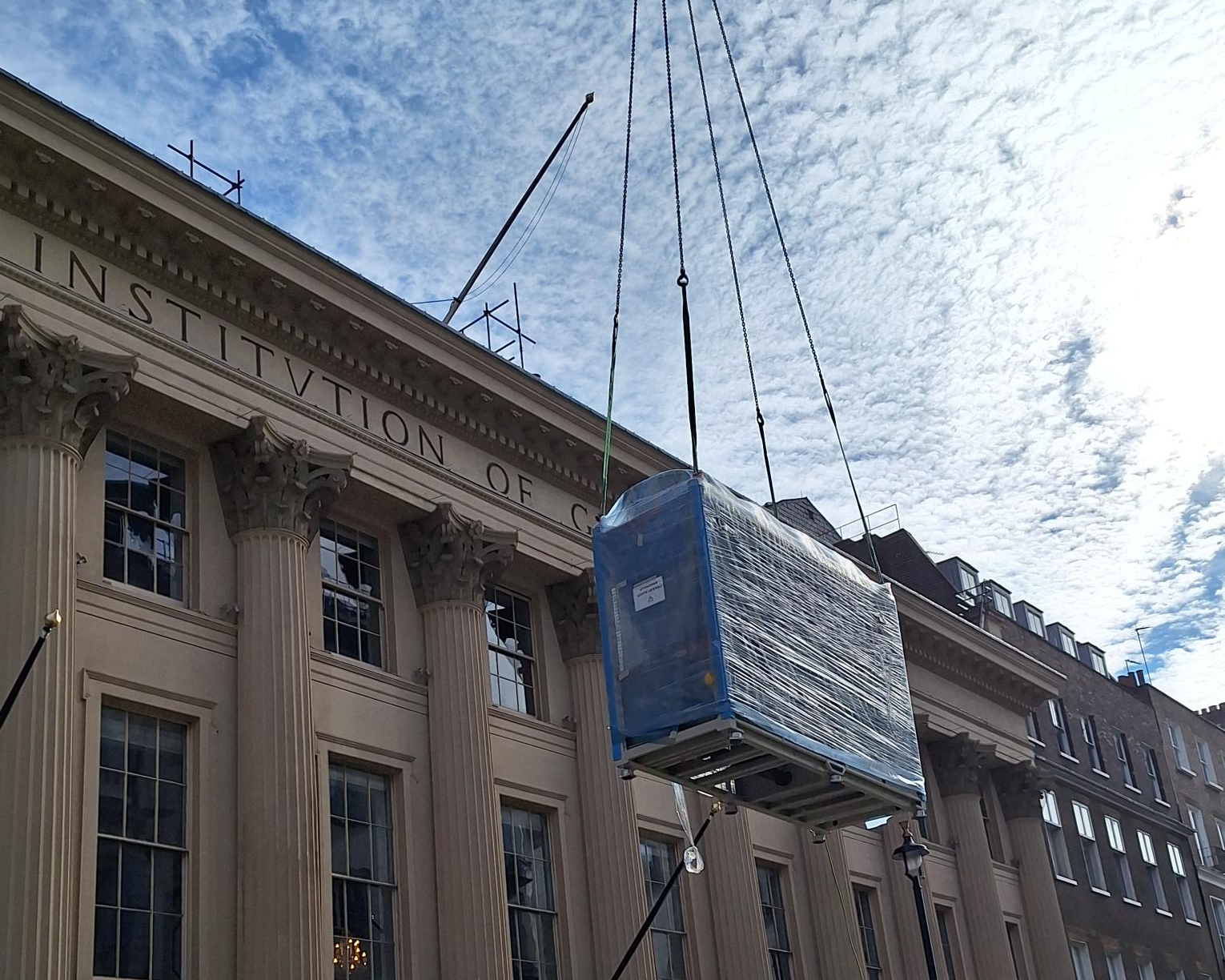
Evans continued: "What made it genuinely fascinating was doing all of that while the building stayed operational as far as possible. Every crane lift, every roof installation, every system changeover was planned around the day-to-day life of the building.
Evans added: "Beyond the technical achievement, there's a real sense of history here. Seeing a Grade I listed building lead the way as an example for decarbonisation at this scale, feels like a full circle moment. It's the kind of project you're proud to be part of."
Picture: An image of a piece of equipment being lifted by crane outside the Royal Institution.
Article written by Dave Mapps | Published 15 June 2026
BRE has revealed the winners of its annual BREEAM Awards 2026 - a celebration of the projects, organisations and people leading the way in sustainable building design,...
Read Full ArticleWaste to Wonder Worldwide has been formally presented with The King’s Award for Enterprise in Sustainability 2026 at a special ceremony held at Fairfield College in...
Read Full ArticleTransport for London (TfL) has unveiled its updated Corporate Environment Plan1, which sets out how TfL will continue to take action to improve air quality, reduce carbon...
Read Full ArticleMichelle Knowles, Associate Surveyor in the Commercial Property Management team at Fisher German, explores why sustainability in commercial property management is...
Read Full ArticleSunbelt Rentals UK & Ireland has achieved the EcoVadis Platinum award, placing the business in the top 1% of companies assessed globally for sustainability...
Read Full ArticleSustainability reporting across major infrastructure has become increasingly sophisticated. Airports and transport hubs now measure greenhouse gas (GHG) emissions across...
Read Full ArticleArtus Air heating and cooling solutions are being installed at British Land’s new London head office at 20 Triton Street,...
Read Full ArticleChamberlaine Cleaning Services, in collaboration with Nordic Chem, has won the Sustainable Collaboration Award at the 2025 Metsä Tissue Sustainability Awards. The...
Read Full ArticleJanitorial distributor Jangro has been awarded a medal for its sustainability performance. The EcoVadis Gold Medal is a sustainability rating based on the Ten...
Read Full ArticleMetsä Group is launching its 2025 Sustainability Awards, in partnership with the Cleaning & Services Support Association. The event aims to spotlight...
Read Full Article