.gif)
.gif)


Artus Air Supports British Land’s Sustainable HQ Ambition
Artus Air heating and cooling solutions are being installed at British Land’s new London head office at 20 Triton Street,...
Read Full Article

The Leading News & Information Service For The Facilities, Workplace & Built Environment Community
Sustainability reporting across major infrastructure has become increasingly sophisticated. Airports and transport hubs now measure greenhouse gas (GHG) emissions across Scope 1, 2 and 3, publish reduction targets and track year-on-year progress. That progress matters, and the discipline behind it represents a significant shift in how infrastructure organisations approach environmental responsibility. However, events that fall outside ‘business as usual’ raise a more difficult question: what happens when the largest environmental impact comes from something the reporting framework is not designed to fully capture?
The 2023 loss of Luton Airport’s Terminal Car Park 2 (TCP2) offers a useful case study not because of how the incident started, but because of how its environmental consequences are accounted for. London Luton Airport’s Sustainability Report 20241 classified the fire as a non-business-as-usual (BAU) emergency. As such, the primary emissions associated with the incident itself were treated as outside the core reporting boundary, while emissions linked to demolition and deconstruction activities were recorded as part of Scope 3 construction-related impacts.
From a reporting perspective, this follows accepted practice. Exceptional events are often separated from baseline figures to maintain comparability between reporting years. However, the environmental reality behind the figures is harder to ignore.
Analysis suggests that the total carbon impact associated with rebuilding the lost structure alone, including replacement materials and associated works may be equivalent to three to four years of the airport’s reported Scope 1 and Scope 2 operational emissions. Let that sink in. One event, a fire attracting global attention, that is “non-business-as-usual” is equivalent to three to four years of their reported emissions. All it gets is a footnote bubble in the Sustainability Report. This is not a marginal adjustment. It represents the loss of several years of environmental progress in a single incident.
Sustainability in practice
This highlights a broader issue in how sustainability is defined in practice. Most carbon strategies focus on predictable sources of emissions such as energy use, transport and operational efficiency. These are areas where incremental improvements can be measured and reported. What they rarely address is the environmental consequence of sudden infrastructure loss.
When major assets are lost prematurely, the environmental impact is immediate. Replacement requires new materials, new transport movements and new construction activity, all carrying embodied carbon. In other words, the environmental investment already made in the original structure is written off, and the carbon cost of building must be paid again.
None of this diminishes the operational response that followed the TCP2 loss. Maintaining airport operations under disruption reflects significant capability and planning. But resilience should not be understood only as the ability to recover. From a sustainability perspective, resilience also means limiting the scale of loss in the first place.
This distinction will become increasingly important as emissions targets tighten and whole-life carbon assessments become standard practice. Many sustainability frameworks assume continuity, with assets that will perform throughout their intended lifespan. Events such as the Luton airport car park fire challenge that assumption by showing how rare but high-impact incidents can dominate long-term environmental performance.
Environmental resilience
When the carbon cost of rebuilding outweighs several years of operational emissions, resilience becomes an environmental issue as much as an engineering one. Measures that limit the scale of damage therefore have a role to play in sustainability strategy, not just safety planning.
Automatic sprinkler systems are traditionally associated with life safety and property protection. Increasingly, they should also be understood as environmental safeguards. By controlling incidents at an early stage, sprinklers can reduce structural damage, limit material loss and avoid the need for large-scale reconstruction, directly reducing the carbon cost of recovery. That is why the new car park has sprinklers!
There is a risk that sustainability narratives focus heavily on incremental gains while overlooking the potential for large-scale setbacks. Reporting frameworks struggle to reflect the environmental consequences of sudden disruption. As a result, organisations may appear to be progressing steadily toward net zero while remaining vulnerable to events capable of reversing that progress in a matter of hours.
The lesson from Luton is not about reporting methodology alone but about recognising that durability and resilience sit at the heart of sustainability. The most significant carbon events are not always those recorded in annual reports. Sometimes they are the exceptional ones, the losses that sit outside ‘business as usual’ that carry the greatest environmental cost.
1. London Luton Airport’s Sustainability Report 2024 – see here.
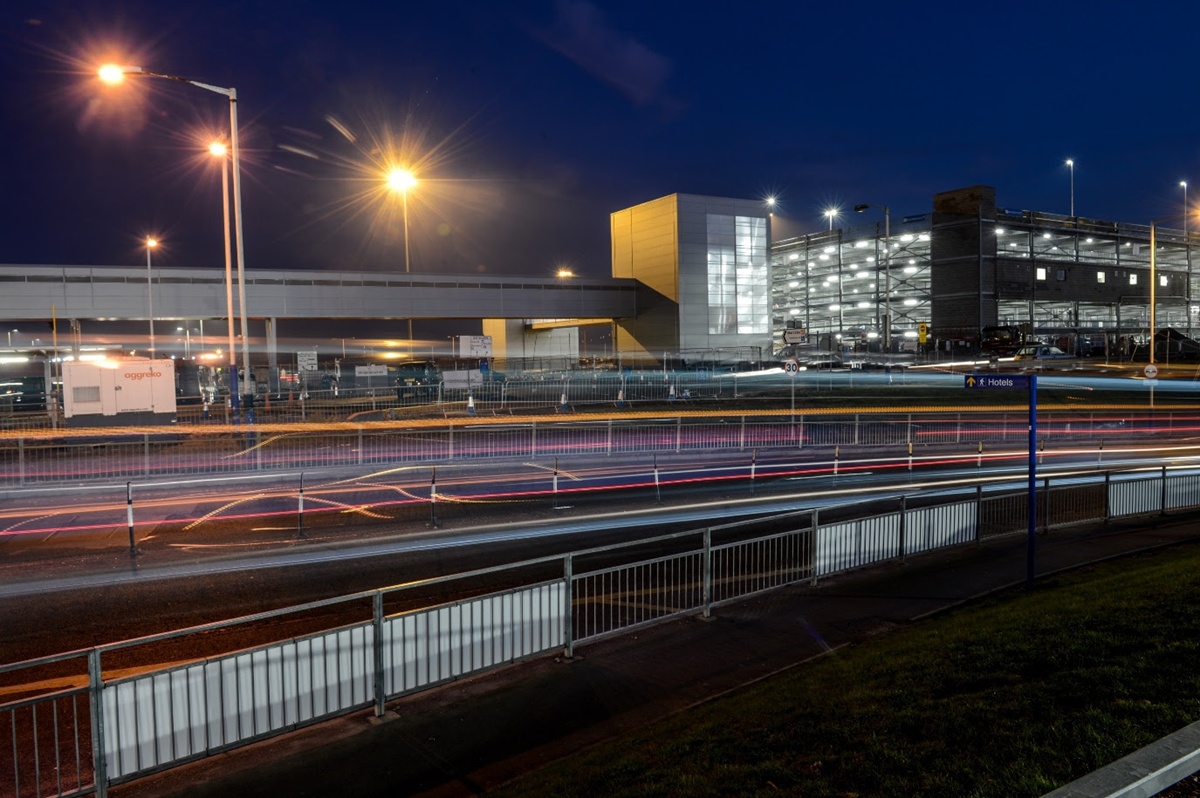
Picture: An image of Luton Airport.
Article written by Tom Roche | Published 01 June 2026
Artus Air heating and cooling solutions are being installed at British Land’s new London head office at 20 Triton Street,...
Read Full ArticleBRE has revealed the winners of its annual BREEAM Awards 2026 - a celebration of the projects, organisations and people leading the way in sustainable building design,...
Read Full ArticleWaste to Wonder Worldwide has been formally presented with The King’s Award for Enterprise in Sustainability 2026 at a special ceremony held at Fairfield College in...
Read Full ArticleIain Cox, Chairman of the Business Sprinkler Alliance (BSA), continues to press the case for a fundamental rethink of how fire safety regulations treat housing for...
Read Full ArticleTransport for London (TfL) has unveiled its updated Corporate Environment Plan1, which sets out how TfL will continue to take action to improve air quality, reduce carbon...
Read Full ArticleMitie has published its 2026 ESG Report, Pathways to Sustainable Futures, highlighting progress across its environmental, social and governance commitments. The...
Read Full ArticleNew international research from Mulberry Marketing Communications has revealed that professional hygiene buyers are demanding more from their suppliers - combining...
Read Full ArticleMichelle Knowles, Associate Surveyor in the Commercial Property Management team at Fisher German, explores why sustainability in commercial property management is...
Read Full ArticleSunbelt Rentals UK & Ireland has achieved the EcoVadis Platinum award, placing the business in the top 1% of companies assessed globally for sustainability...
Read Full ArticleThe Royal Institution (Ri) is on track to achieve a remarkable 42% reduction in carbon emissions at its Grade I listed Georgian building – surpassing its original...
Read Full Article