.gif)
.gif)


Delivering AMP8 Will Require More Than Investment
Gary Wilde, Technical Officer, British Pump Manufacturers Association (BPMA), discusses how the pump sector has a vital role to play in ensuring that...
Read Full Article.png)

The Leading News & Information Service For The Facilities, Workplace & Built Environment Community
The British Pump Manufacturers Association (BPMA) believes that adopting a lifecycle approach to equipment procurement is one of the most effective ways to improve both operational efficiency and financial performance.
As organisations across industry continue to seek ways to reduce operating costs and improve sustainability, the importance of regular energy audits has never been greater. For many industrial, commercial and manufacturing facilities, pumping systems represent one of the largest consumers of electricity, making them a prime target for energy reduction initiatives. Yet too often, the true cost of these systems is judged solely on their purchase price, rather than the cost of operating them over many years of service.
Energy audits provide an invaluable opportunity to understand where energy is being consumed, identify inefficiencies and prioritise improvements that can deliver measurable savings. While lighting, heating and compressed air systems often receive considerable attention, pumping systems can account for a significant proportion of an industrial site's total electricity consumption. Even relatively modest improvements in pump efficiency can therefore have a meaningful impact on both operating costs and carbon emissions.
Selecting the right pump is only part of the equation. True efficiency comes from optimising the entire pumping system, ensuring pumps, motors, controls and pipework all work together as intended. Oversized pumps, poorly specified equipment or systems operating away from their Best Efficiency Point (BEP) can waste considerable amounts of energy throughout their operational life.
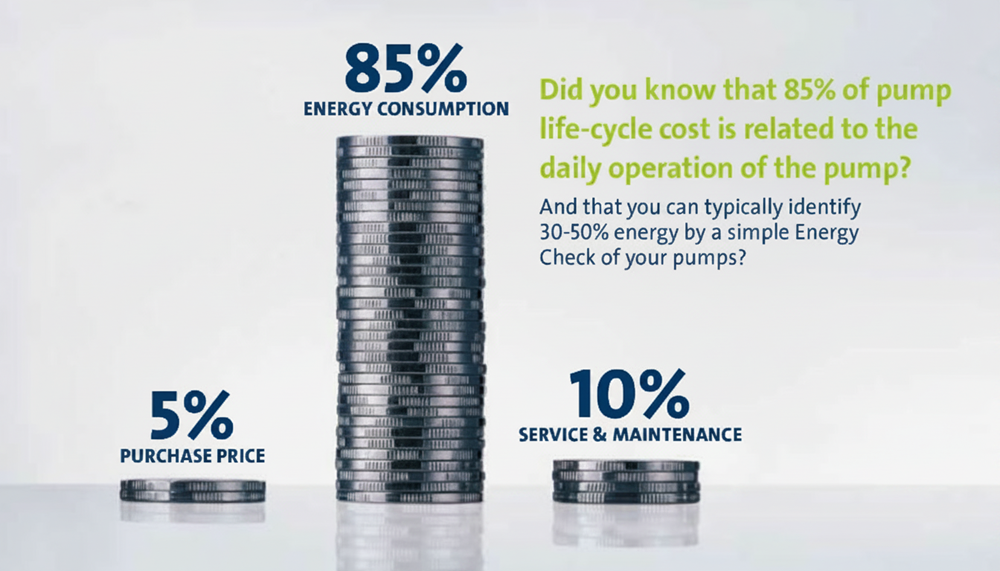
This is where the principles of Total Cost of Ownership (TCO) and Whole Life Costing (WLC) become essential. While the purchase price of a pump may represent only a small proportion of its lifetime cost, the energy required to operate it over 10, 15 or even 20 years can account for well over 80 per cent of the total expenditure.
Despite this, many procurement decisions continue to be influenced primarily by initial capital cost. One of the reasons for this is the traditional separation of Capital Expenditure (CapEx) and Operational Expenditure (OpEx) budgets. Those responsible for purchasing equipment are often tasked with minimising capital investment, while the ongoing cost of the energy required to operate that equipment falls under a completely different budget and, frequently, a different department.
This disconnect can inadvertently encourage false economies. A lower-cost pump may satisfy an immediate purchasing objective, but if it consumes significantly more electricity over its lifetime, the organisation could ultimately spend many times the original saving in additional energy costs.
Conversely, investing in a higher-efficiency pumping system may require a modest increase in capital expenditure, but the resulting reduction in energy consumption can often deliver remarkably short payback periods. When operational savings are factored into procurement decisions, higher-quality equipment frequently proves to be the most economical option over its lifetime.
The benefits extend well beyond the balance sheet. Every unit of electricity saved contributes towards lower carbon emissions, helping organisations meet increasingly demanding environmental targets while supporting wider sustainability ambitions. As pressure grows to decarbonise industrial operations, energy-efficient pumping systems have an increasingly important role to play.
The BPMA advocates a holistic, system-wide approach to pump selection, installation and operation. Rather than focusing solely on the pump itself, engineers should consider the performance of the complete system to maximise efficiency, reliability and long-term value.
For organisations looking to build this expertise, the BPMA's Certified Pump Systems Auditor (CPSA) training course provides the knowledge and practical skills needed to assess existing pumping systems, identify opportunities for energy reduction and make informed investment decisions based on lifecycle performance rather than purchase price alone.
Picture: An image showing the breakdown of a pump life-cycle cost.
Article written by Dave Mapps | Published 25 August 2026
Gary Wilde, Technical Officer, British Pump Manufacturers Association (BPMA), discusses how the pump sector has a vital role to play in ensuring that...
Read Full ArticleWayne Rose, Chief Executive at the British Pump Manufacturers Association (BPMA) looks at how digitalisation is rapidly reshaping the UK pump industry, moving it beyond...
Read Full Article