

.gif)
.gif)

UK Mechanical & Electrical Sector Holds Firm
The mechanical & electrical (M&E) contracting market has shown impressive resilience in the face of challenging economic conditions, according to a new Top 30 UK...
Read Full Article

The Leading News & Information Service For The Facilities, Workplace & Built Environment Community
According to Nick Maggs, Managing Director of Hard Services at OCS, market growth in the hard services sector is increasing exposure and that is fundamentally reshaping how suppliers are selected.
The hard services market for facilities management is experiencing rapid growth, with forecasts projecting a compound annual growth rate of 9.9% between 2026 and 2033. This is being driven by rising demands for building safety, tighter regulation and more complex, energy-efficient infrastructure across HVAC, mechanical, electrical and plumbing maintenance.
But as asset bases expand and estates become more complex, customers across defence, government and other mission-critical environments are becoming less tolerant of delivery risk.
Growth is Increasing Scrutiny
For customers, growth has amplified the cost of getting supplier decisions wrong. As a result, access is being restricted earlier in procurement, with less appetite to take on delivery risk or compensate for weak operating models. In practice, that means fewer suppliers making it through qualification stages, even in a buoyant market.
Engineering capability, security clearance and competitive pricing are still essential, but they no longer secure trust on their own. Customers increasingly expect proof that suppliers can control risk consistently, across large and complex portfolios.
Operational Credibility is Now the Deciding Factor
Once suppliers are shortlisted, credibility is increasingly tested against the realities of live delivery rather than headline capability. Defence estates, for example, are made up of dispersed portfolios that include secure operational bases, training environments, accommodation, utilities infrastructure and strategic sites, often spread across wide geographies.
Operating across these estates requires providers to manage multiple workstreams simultaneously while maintaining security protocols, safe systems of work and consistent compliance, often under changing operational conditions. Security clearance may be a prerequisite, but it does little to demonstrate whether an organisation can actually function in these environments day to day. Customers are looking for evidence that suppliers already understand how engineering work is controlled in practice. This can include how access is managed, how tasks are authorised and how delivery holds together when conditions change.
Without that operational maturity, suppliers may appear capable on paper, but struggle to sustain delivery once exposed to the realities of secure and mission-critical estates.
Specialist Environments Expose Weak Operating Models
Data centres illustrate this pressure particularly clearly. In these environments, engineers are working directly on infrastructure that supports uptime and resilience. Tasks such as maintaining electrical systems, cooling plant or backup power cannot be treated as routine maintenance.
Whether it’s an incorrect set point, an unauthorised intervention of a lack of contextual understanding, mistakes can have immediate and visible consequences. As a result, customers expect providers to show proven experience in data centre environments, as opposed to just general engineering competence.
Compliance Performance Now Determines Future Opportunity
In regulated and politically sensitive environments, compliance is no longer assessed in isolation. Performance against statutory and client-mandated requirements actively shapes what work a provider is trusted with next.
On defence estates, even minor lapses can escalate rapidly, moving from a technical issue to a contractual, leadership, or reputational concern. In some cases, compliance performance can even determine whether a provider is invited to bid for future phases of work at all.
As a result, customers are placing greater emphasis on consistent compliance, clear governance and credible assurance than they did previously.
Manual Delivery Models Are Being Tested
Many large estates still rely heavily on manual inspection to demonstrate compliance. Engineers attend site, conduct visual checks, produce certificates and upload evidence.
While this remains common practice, it is under growing strain as estates scale. Where building management systems and live asset data are available, customers increasingly expect issues such as inefficient performance, incorrect set points or early indicators of asset failure to be identified before they become operational problems.
This is leading to closer scrutiny of delivery models that rely solely on periodic inspection and retrospective evidence, rather than ongoing visibility and control.
The Advice to Suppliers: Prove Discipline, Not Ambition
Taken together, these pressures explain why access to high-security and mission-critical estates is tightening, even as the overall market grows.
In practice, customers are narrowing their supplier base to organisations that can evidence proven delivery at scale in secure and regulated environments, such as critical national infrastructure, transport and logistics hubs, healthcare estates, and large public sector portfolios. Operational discipline has become the entry price.
Nick Maggs, Managing Director of Hard Services at OCS, said: “As more assets come under management and regulatory expectations rise, the cost of failure increases. Customers are concentrating risk and that’s changing how credibility is judged.”
Maggs added: “In high-security and mission-critical environments, it’s not enough to say you can deliver the work. Customers want confidence that you understand the risk you’re taking on, and that you can control it predictably, day in and day out.”
Maggs highlighted: “In data centres, the cost of failure is massive. A hard services provider does not operate remotely. Engineers physically maintain critical systems and work on infrastructure that supports uptime and resilience. If something goes wrong, the consequences are immediate and potentially severe. That reality changes what customers look for in a supplier.”
Maggs concluded: “In these environments, trust is built through evidence. Customers are looking for proof that the basics are being done properly, every time. Without that, everything else becomes academic.”
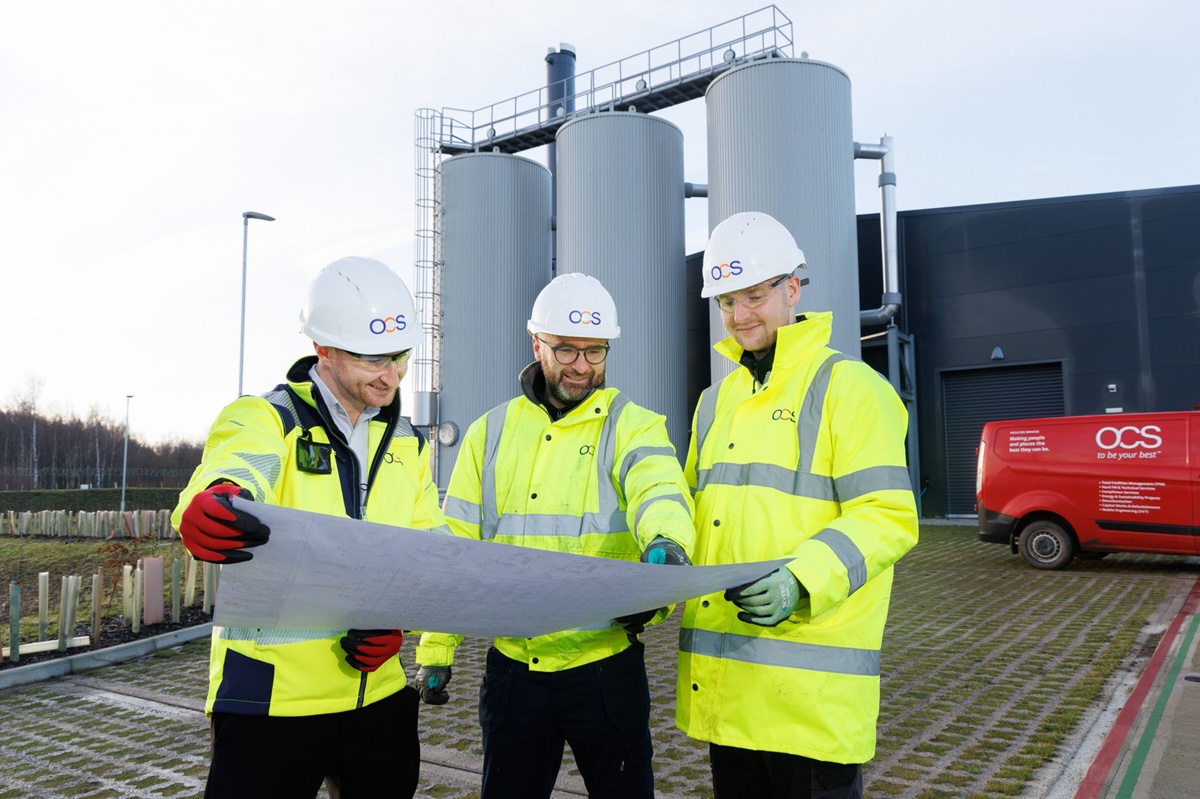
Picture: An image of three OCS employees looking at some plans outside a Client site.
Article written by Nick Maggs | Published 12 May 2026
The mechanical & electrical (M&E) contracting market has shown impressive resilience in the face of challenging economic conditions, according to a new Top 30 UK...
Read Full ArticleBRE has revealed the winners of its annual BREEAM Awards 2026 - a celebration of the projects, organisations and people leading the way in sustainable building design,...
Read Full ArticleArtificial intelligence (AI) is growing strongly across Europe, with AI clusters emerging in major office markets and smaller academic and specialist hubs, according to...
Read Full ArticleAs investment in UK data centres continues to gather pace, Pieter Swart, Head of Specification, Fire & Modular Systems at Grundfos, is urging operators to prioritise...
Read Full ArticleDavid Axon, chairman of AirPlus Renewables, explains why the rapid growth of data centres is exposing the limits of a centralised energy system and why generating more...
Read Full ArticleAs the UK experiences increasingly frequent periods of extreme heat, Graeme Hamilton, Managing Director of Energy at OCS, argues that cooling is rapidly becoming critical...
Read Full ArticleOCS has announced its recommended acquisition of Mitie, bringing together two complementary businesses specialising in facilities management and transformation....
Read Full ArticleOCS has completed the acquisition of City Group Security, an established nationwide security company founded in 1993 and ranked among the top 30 security businesses in...
Read Full ArticleOCS has appointed Matt Kent as UK and Ireland Director of Engineering, following his transition from EMCOR UK after OCS’s acquisition of the business in December...
Read Full ArticleOCS has secured a contract extension and portfolio expansion with British Land building on an eight-year partnership to deliver soft services across more than 50 sites...
Read Full Article