Daikin Applied (UK) Launches Flexible, Low-Carbon Ventilation Unit For Large Spaces
13 April 2026
Daikin Applied (UK) has expanded its air handling unit portfolio with the launch of its new Vertical DX series, a floor-standing, plug-and-play solution designed to deliver energy-efficient ventilation and precise climate control in large indoor environments.
Engineered for seamless integration with Daikin VRV and ERA systems, the Vertical DX unit provides a practical alternative to traditional centralised ventilation systems, particularly in applications where installation constraints, variable occupancy, and energy performance are key considerations.
From logistics hubs and distribution centres to sports halls and multi-use venues, large indoor environments present complex ventilation challenges. High air volumes, fluctuating occupancy, and uneven air distribution can all impact comfort, indoor air quality (IAQ), and energy efficiency.
Traditional systems often struggle to adapt efficiently to these conditions, leading to oversizing, increased energy consumption, and inconsistent performance.
The Vertical DX unit has been developed to address these challenges through a decentralised ventilation approach. By delivering air treatment closer to occupied zones, it reduces system losses, improves responsiveness, and enables more accurate control of airflow and temperature.
The Vertical DX unit supports advanced control strategies, enabling precise temperature management and seamless integration into wider building systems.
Units can be connected to a single outdoor system, allowing scalable configurations across multiple zones. Compatibility with centralised building management systems ensures full visibility and control across the HVAC system.
At the heart of the system is a factory-installed, fully wired direct expansion (DX) kit, allowing refrigerant to circulate directly within the unit. By eliminating the need for a secondary water circuit, the system reduces energy losses, system footprint, and installation requirements.
With increasing regulatory pressure and a growing focus on carbon reduction, building owners and operators are seeking solutions that improve efficiency without requiring major infrastructure changes.
The Vertical DX unit supports this transition by enabling high-efficiency, decentralised ventilation using low-GWP refrigerants such as R-32. Its flexibility makes it particularly well-suited to refurbishment and upgrade projects, where maintaining building operation during installation is critical.
A key advantage of the Vertical DX series is its installation flexibility, particularly in retrofit and space-constrained projects.
The unit’s compact, floor-mounted design allows it to be installed with minimal disruption, often without the need for ductwork. This significantly reduces installation time, cost, and complexity while maintaining the option for ducted configurations where required.
Multiple configuration options, including front, side, or top air discharge, and left- or right-hand connections, enable easy integration into a wide range of building layouts.
Paul Harris, National AHU Sales Manager at Daikin Applied (UK), said: “The launch of the Vertical DX series reflects a growing need for more flexible and efficient ventilation solutions in large, complex spaces. By combining decentralised design with integrated DX technology, we are helping customers simplify installation, reduce energy consumption, and maintain high levels of comfort, even in the most demanding environments.”
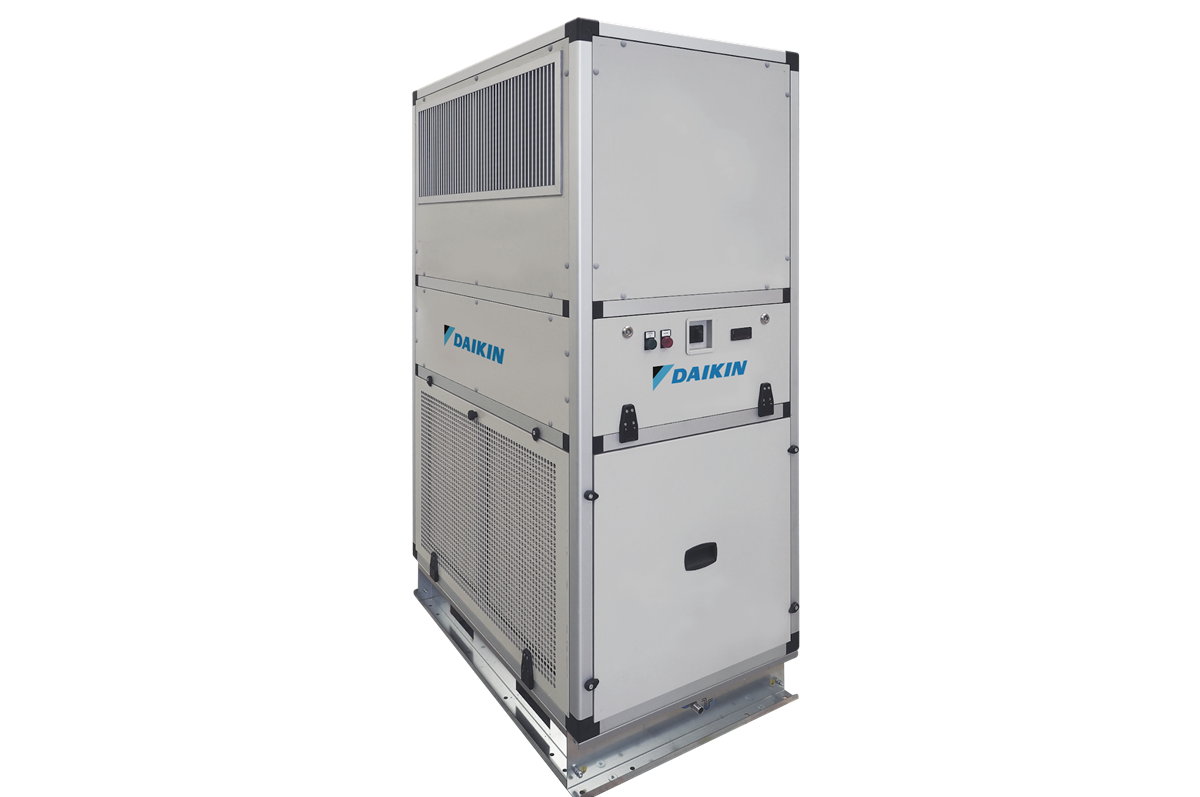
Picture: An image of the Daikin Applide (UK) Vertical DX Unit.
Article written by Dave Mapps | Published 13 April 2026
60% Of Businesses Look To Adapt Operations In Response To Extreme Heat
According to the Q2 Barclays Business Prosperity Index1, six in 10 businesses surveyed (60 per cent) have either increased investment to adapt to extreme heat (37 per...
Daikin Rental Solutions Accelerates UK Expansion With Major Multi-Technology Fleet Investment
Daikin Rental Solutions has announced a major expansion of its UK rental fleet, combining new high-capacity cooling systems, low-carbon heating solutions, process cooling...
BESA Warns of Critical Fire Safety Issue in Ventilation Systems
The Building Engineering Services Association has issued an urgent warning about a potential fire safety weakness in a large number of building ventilation...
The advice includes how to ventilate rooms whilst keeping them warm, monitoring indoor air quality, and safely ventilating vehicles.
What are the Legal...
Smart Ventilation System Given Passivhaus Certification
SAV Systems' AirMaster AM 1000, a mechanical ventilation unit, has been awarded Passivhaus Component certification.
The flagship AM 1000 is the first...
The temporary shutdown of a building can create hazards for returning occupants, one being mould where there is humidity and lack of ventilation.
Stuart Kerr,...
Mitie has launched a new air disinfection service using ultraviolet light to help eradicate harmful bacteria, viruses, funghi and mould.
Partnering with Luxibel, the...
HSE Provides Updated Advice on Ventilation During COVID
The Health and Safety Executive has expanded its advice for employers to provide adequate ventilation in their workplaces during the pandemic.
This guidance is...
Sterilisation from CPA’s Biojet to Enable Safer Indoor Air
Biojet, from CPA Engineered Solutions, is a high volume air cleaning device that claims to deactivate up to 99.99 per cent of viruses (including coronavirus), mould and...
Ventilation – The Importance of Fresh Air in COVID-Security
Ventilation measures are considered the most vital engineering mechanisms in infection control within buildings.
Research from REHA and CIBSE shows that adequate...
Rinnai Director, Chris Goggin, looks at how heat pumps being classified as a main solution towards decarbonisation compares to the direction of the UK’s low carbon heating and hot water technology market. Click Image To Read More
Nationwide Air Conditioning Extends David Lloyd Contract
Their 15-year partnership extended to cover Ireland, over 115 clubs and over 10,000 assets. Click Image To Read More
Andy Burnham: A New Direction On NetZero & Possible Future Pathways?
Rinnai Director Chris Goggin evaluates the new potential path of UK emissions reductions under Prime Minister Andy Burnham. Click Image To Read More
Boat Party 2026 Highlights
9 July 2026
400 FM professionals gather on the River Thames. Learn More Here >>
2027 Date announced soon.
Risk Now A Critical Piping System Specification
James Griffiths, Head of Projects at GF Building Flow Solutions, explores how pipe theft forces industry to reconsider long-established specification decisions. Click Image To Read More
Energy Transition Update
Guest Editor, Daniel Lynn, gives examples demonstrating the direction of a collaborative and global energy transition from separate international regions. Click Image To Read More


.gif)
.gif)