.gif)
.gif)


Skanska Wins Contract for 20 Ropemaker Street
Skanska has won a £240 million contract to construct 20 Ropemaker Street in Central London for Great Elm Assets Limited, in association with Old Park Lane...
Read Full Article.png)

The Leading News & Information Service For The Facilities, Workplace & Built Environment Community
Can the built environment unlock substantial carbon savings by scrutinising mechanical, electrical and plumbing systems?
Max Gibbens, Senior Environmental Consultant at chapmanbdsp, explores opportunities for a secondary marketplace for reused MEP systems to accelerate the transition to a truly circular economy in the construction sector.
Max has over ten years of experience within the construction industry, leading on multiple BREEAM and embodied carbon projects on sites up to 15,000m2.

Picture: a photograph of Max Gibbens. Image Credit: chapmanbdsp
"One of the main barriers to achieving circularity in MEP systems is not the technology itself, but rather the challenge of overcoming both perceived and actual risks, along with a general lack of confidence in reused components."
In the drive towards net-zero, the built environment must increasingly reckon with embodied carbon, the emissions associated with materials and construction, rather than simply the operational phase of a building’s life. MEP systems, often overlooked in embodied carbon calculations due to their technical complexity, are now under greater scrutiny. And nowhere is this more crucial than in the exploration of circular economy principles, where the reuse of materials, components, and systems can deliver substantial carbon savings.
One of the main barriers to achieving circularity in MEP systems is not the technology itself, but rather the challenge of overcoming both perceived and actual risks, along with a general lack of confidence in reused components. Lighting, for example, can often be reused, repaired or upcycled in some way, yet hesitation remains among design teams due to concerns about durability, performance standards, and warranty of MEP systems.
MEP systems are also bound by operational carbon, which unlike structural or architectural materials, will keep using energy and therefore produce carbon throughout its life. As modern systems can be more efficient and reduce operational energy, there may be situations where new products pay back their embodied carbon with energy savings. Newer equipment may also reduce the global warming potential of refrigerants where existing systems cannot be retrofitted. When selecting MEP equipment, engineers need to balance the short and long-term environmental impacts, adding further to the complexity of the situation.
Another key challenge with a corresponding opportunity lies in establishing a reliable and scalable secondary marketplace for MEP equipment. Unlike the more typical reuse of elements like structural steel or internal glass partitions, MEP systems, ductwork, pipework, lighting, and plant elements such as fan coil units, are often replaced wholesale during refurbishment or demolition. These components are frequently sent for recycling, which, while preferable to landfill, still involves a high carbon cost due to melting, smelting, and reprocessing.
A true circular model would see many of these elements refurbished, certified, and reused, ideally through a systematised exchange network. A further benefit of this model is the ability to scale reuse. Rather than each project attempting to forge its own reuse pathway, often hampered by time, cost, and regulatory hurdles, a centralised secondary market could facilitate standardised specifications, third-party certification, and transparent carbon accounting. We are already seeing reuse pathways and methods present within lighting, as British Standard BS 8887-221:2024 gives a steer to remanufacturing.
What's needed is a robust logistical and commercial model for circularity. One idea that's becoming more popular is to set up intermediary refurbishers, organisations that buy unused MEP components, refurbish and recertify them, then sell them again. This would allow developers to move away from relying only on what's already available on-site and instead access a broader, quality-checked supply. An enabler of this secondary market would be bringing companies together to collaborate within a single framework, using collective storage banks instead of the fragmented approach currently seen. Such a coordinated approach would not only de-risk circularity but actively promote it whilst making the framework financially and commercially sustainable.
Material innovation and supply chain transparency are also advancing in terms of carbon reduction. Five or six years ago, it was almost impossible to obtain accurate carbon data for MEP products. Now, with software platforms maturing and Environmental Product Declarations (EPDs) becoming more widespread, engineers are better equipped to make informed choices. Manufacturers are also increasingly publishing embodied carbon data using, for example, the CIBSE TM65 methodology, which helps environmental consultants balance performance with sustainability goals. Furthermore, Material Passporting as a practice is progressing, removing uncertainty for future building owners to reuse fixtures, and aiding accurate software modelling.
Yet even with these advances, MEP remains constrained compared to other disciplines in the construction programme, when it comes to wholesale material substitution. Whereas for example, a structural engineer might switch to low-carbon concrete or alternative slab designs, MEP engineers are more restricted by the inherent performance and regulatory demands of their systems. Still, using lower-carbon metals, improved manufacturing methods, and energy-efficient product designs is making a clear difference, especially when measured with whole-life carbon analysis tools.
Software plays a crucial enabling role in this. Tools that allow for scenario testing, such as replacing a lighting or indeed MEP package that was manufactured far overseas with one that was made or remanufactured more locally - provide immediate clarity on carbon impacts. Similarly, circularity options can be assessed to determine if the carbon payback is achievable when comparing embodied carbon and operational carbon, allowing project teams to make informed decisions quickly and transparently. This helps reduce the risk that a low-carbon solution in one area might lead to unexpected increases in emissions elsewhere, especially over the asset's full lifecycle.
Manufacturers, too, are responding to market signals. Some firms are now disclosing full lifecycle data for HVAC systems, embracing hybrid systems and higher-efficiency plant equipment to reduce both operational and embodied emissions.
Another factor within the carbon saving conversation is the electrification of buildings which has become the default strategy across most commercial developments. Whereas gas boilers and CHP were once standard, the vast majority of projects now specify heat pumps as their primary heating source. As the national grid continues to decarbonise steadily, buildings with all-electric systems will see ongoing reductions in operational carbon. This shift moves the conversation further toward embodied emissions, highlighting the importance of addressing materials and circularity.
As consultants working in the MEP space, we are increasingly involved from the earliest project stages, typically RIBA Stage 2, to define whole-life carbon and circularity strategies in concert with energy modelling and certification goals such as BREEAM or NABERS. Carbon modelling is no longer an isolated task but a cross-departmental activity that intersects with cost planning, specification, and even procurement. Clients, particularly those with strong ESG frameworks, are engaging more deeply than ever, often attending regular sustainability meetings and pushing for best-in-class outcomes.
The future of carbon saving in MEP lies not in a single solution, but in a coordinated framework of tools, data, logistics, and design culture. Circularity, enabled by a mature secondary market, is central to this. With the right policy support, industry collaboration, and technical infrastructure, reused and refurbished MEP components can shift from a niche sustainability feature to a mainstream strategy.
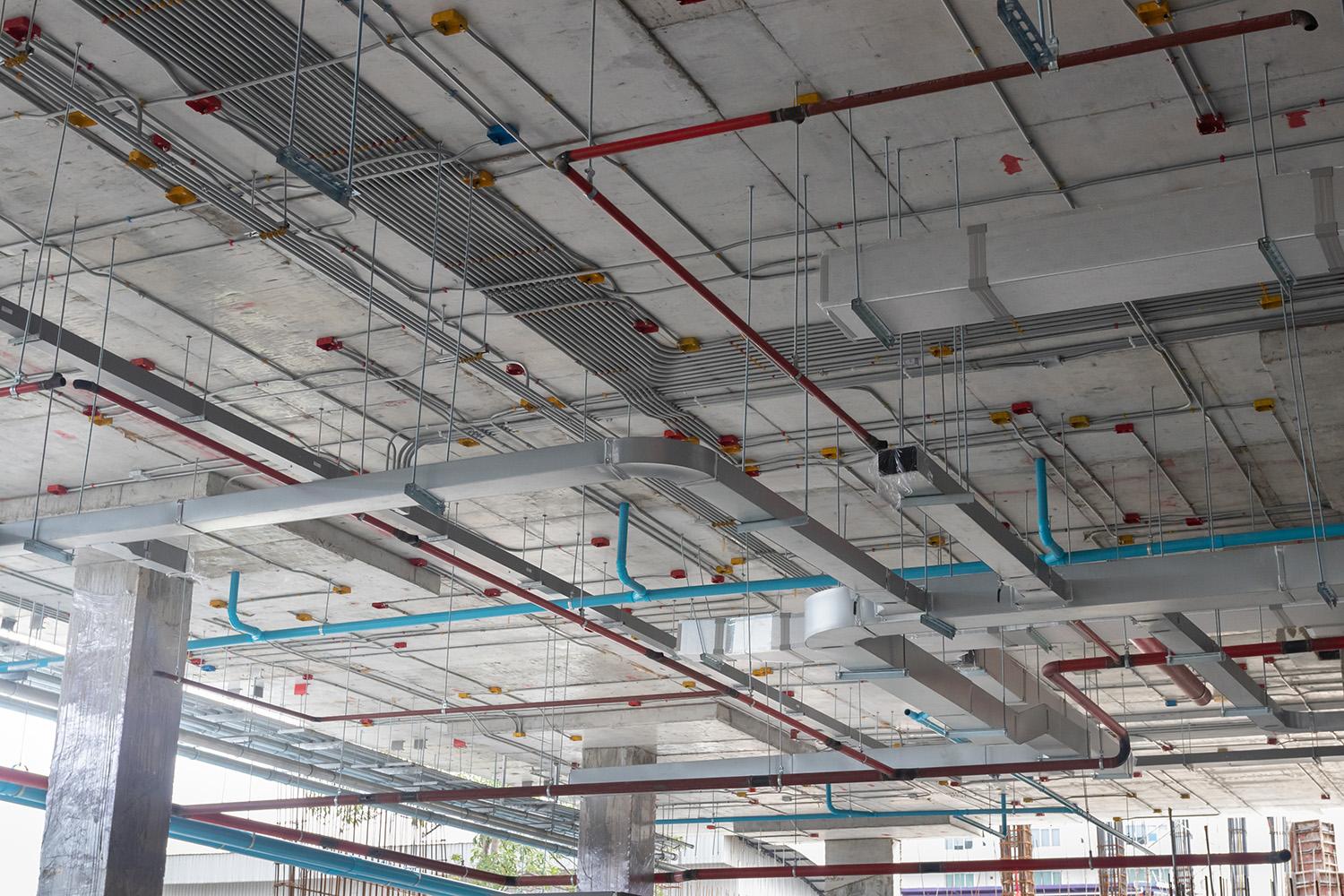
Picture: a CGI of a network of exposed utility lines running across the ceiling of a building under construction. Image Credit: Adobe Stock
Article written by Max Gibbens | Published 04 November 2025
Skanska has won a £240 million contract to construct 20 Ropemaker Street in Central London for Great Elm Assets Limited, in association with Old Park Lane...
Read Full ArticleThe Building Research Establishment (BRE) – an international building science centre – has launched BREEAM Refurbishment and Fit Out Commercial Version 7...
Read Full ArticleThe mechanical & electrical (M&E) contracting market has shown impressive resilience in the face of challenging economic conditions, according to a new Top 30 UK...
Read Full ArticleBuildings and their evidence can now be submitted for verification by Bureau Veritas, allowing robust Net Zero Carbon Aligned claims. The UK Net Zero...
Read Full ArticleWillmott Dixon has secured the £19.3 million first phase of Coleg Gwent's redevelopment of its Crosskeys Campus in Newport, transforming the site into a modern,...
Read Full ArticleEighteen Light Emitting Diode (LED) upgrade projects have been successfully delivered during year two (August 2025 – July 2026) of Imperial's 17-year Net Zero...
Read Full ArticleCommercial and public buildings risk being left behind in the UK's transition to net zero despite more than £40bn of funding, investment and policy support...
Read Full ArticleIn the first of this three-part mini-series ThisWeekinFM speaks to Chris Goggin, Director of Operations at Rinnai UK, the world’s largest manufacturer of gas...
Read Full ArticleWork has started on Aston University’s Carbon Neutral Energy Centre which aims to transform how power is generated and used across the University. It is the...
Read Full ArticleDalkia is proud to announce its appointment by the British Museum to deliver the Energy Centre Programme, a critical component of the Museum’s wider Masterplan....
Read Full Article