.gif)

.gif)

UK Leads in the Future of Post-EV Technology
The UK’s Transportation and Storage sector is now the eighth-fastest growing sector in the country and the second-ranked sector for business growth in the past...
Read Full Article.png)

The Leading News & Information Service For The Facilities, Workplace & Built Environment Community
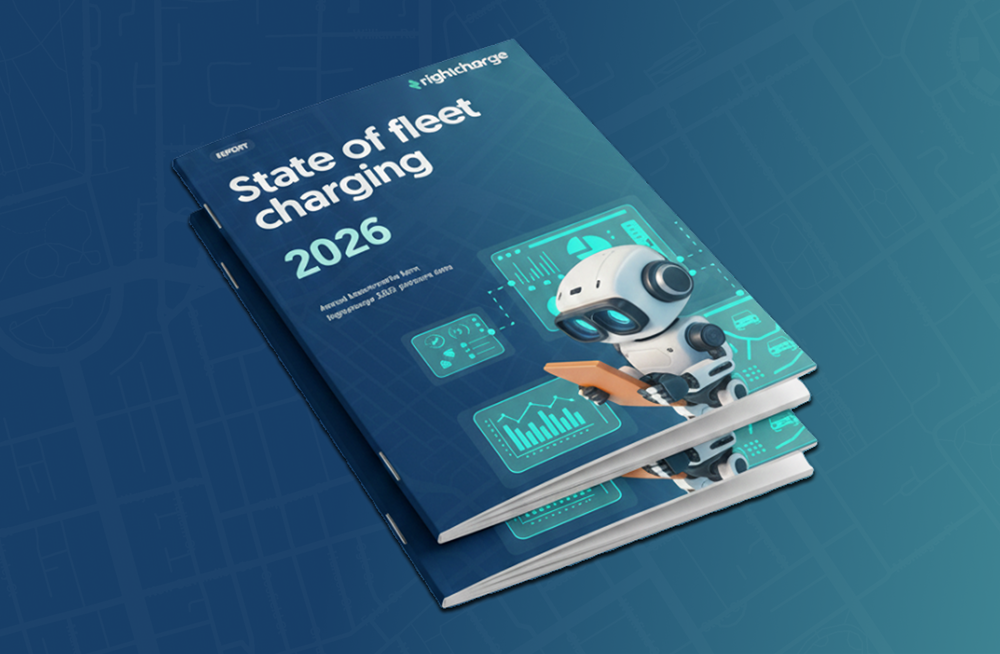
Rightcharge, an EV fleet charging payment platform, has released its 2026 Annual State of Fleet Charging Report.
The report is based on real-world data from tens of thousands of charging sessions and more than 1,000 megawatts of energy delivered to UK fleets during 2025. It collates the data and provides recommendations for delivering cost savings for an electric fleet in 2026.
The Key Findings:
1. Price Disparity Between Public and Home Charging
The report highlights a clear disparity in ‘fuelling’ costs depending on where fleets plug in. Public charging accounted for only 27% of sessions but made up 57% of total fleet spend. While public charging is useful for keeping drivers moving, it often comes with a heavy premium. In 2025, the average cost for public charging was 81p/kWh, whereas charging at home cost an average of 25p/kWh. This means businesses relying heavily on the public network are paying more than three times the price for the same amount of energy.
2. Double Win: Lower Costs and Lower Carbon
The findings prove that for electric fleets, saving money and saving carbon can come hand-in-hand. ‘Smart Charging’ is a key lever - simply time a charge session when energy is cleaner and often cheaper. While 77% of home charging already happens during off-peak hours, only 43% of public sessions do. By shifting more charging to off-peak periods, fleets can cut their charging-related emissions by up to a third. Furthermore, fleets that encourage drivers to switch to a dedicated EV tariff can see the rates drop even further to around 6-7p/kWh, unlocking annual savings of up to £1,300 per driver.
Conclusion: A New Benchmark for Fleets
Rightcharge is calling on businesses to stop obsessing over occasional high-cost public charging sessions and instead focus on the ‘blended average unit rate’. By looking at the average cost across all charging, businesses can get a true picture of their costs and potential savings. In 2025, the average blended unit rate across the Rightcharge platform was 40p/kWh, equating to 11p per mile. Making electric vehicles significantly cheaper to ‘fuel’ than diesel at 15p per mile or petrol at 17p per mile.
Charlie Cook, Founder and CEO of Rightcharge, said, “Transitioning to an electric fleet brings huge benefits, but optimising your charging can help you save even more money. Our latest data shows a big difference in charging costs across the UK fleets. We’ve published this report to give fleet managers the benchmarks that they need to see the true value of electric vehicles.”
The full 2026 State of Fleet Charging Report can be downloaded here.
Picture: An image of the 2026 State of Fleet Charging Report.
Article written by Dave Mapps | Published 05 February 2026
The UK’s Transportation and Storage sector is now the eighth-fastest growing sector in the country and the second-ranked sector for business growth in the past...
Read Full ArticleMitie, the UK’s leading facilities management company, has accelerated past its target to convert 30 per cent of its fleet to zero-emission electric vehicles...
Read Full ArticleWith the Greater Manchester Clean Air Zone launching in May 2022, the shift to clean taxis and other vehicles such as vans is being supported by a range of...
Read Full ArticleDundee City Council in Scotland features one of the most electric-powered fleets in the UK, and has encouraged businesses and individuals to switch to EV. How has their...
Read Full ArticleNew research to mark Fire Door Safety Week reveals that a combination of a surge in lithium-ion battery fires from e-bikes and e-scooters, along with poor fire door...
Read Full ArticleA consortium of businesses has signed an open letter to urge the Mayor of London to rethink ending congestion charge exemption for electric vans. Currently, 100 per...
Read Full ArticleAmogy, a pioneer of emission-free, energy-dense ammonia power solutions, has announced the successful testing of the first-ever ammonia-powered, zero-emission semi-truck....
Read Full ArticleA new study from Juniper Research has found the number of hydrogen vehicles in service globally will exceed one million in 2027, from just over 60,000 in 2022...
Read Full ArticleThe growing versatility of EV fleets and the imminent introduction of airborne variants are pushing infrastructure and technology to new limits. The UK automotive...
Read Full ArticleMatthew Lumsden, CEO of Connected Energy, answers some of the questions he is asked most often about the implication of installing EV chargers. In a new regular...
Read Full Article