Verification To The UK Net Zero Carbon Buildings Standard Is Now Open
06 August 2026 | Updated 05 August 2026
Buildings and their evidence can now be submitted for verification by Bureau Veritas, allowing robust Net Zero Carbon Aligned claims.
The UK Net Zero Carbon Buildings Standard (the Standard) was established in 2022 to provide a consistent, industry-agreed definition of net zero carbon which could cut through greenwash and robustly demonstrate in use performance. Following input from more than 350 industry experts, the Standard (Version 1) was published this March, and its verification scheme opened on July 28.
The Standard covers both the methodology to measure a building’s carbon and energy performance, and the definition of a Net Zero Carbon Aligned building. The definition is conveyed through a number of mandatory limits, targets, and requirements; including removal of fossil fuels; introduction of on-site renewable electricity generation; and limits on upfront embodied carbon and measured in-use energy consumption. To demonstrate these requirements have been met, measured in-use building data must be submitted for third party verification.
Using the Standard is voluntary and allows claimants to align buildings to a 1.5°C science-led pathway, which was created through downscaling UK carbon and energy budgets. Offsets may not be used to meet any of the Standard’s limits, but they can be used once the mandatory requirements have been met to address the residual carbon.
What Role Does Verification Play in a Net Zero Carbon Aligned Building?
Independent third-party checking is mandatory and means that any claims under the Standard are robust. Verifiers will apply expert knowledge to affirm the quality of the evidence, and whether it substantiates the conformity claim. The introduction of verification is a significant milestone for the industry, giving confidence that only buildings with demonstrable low carbon outcomes can earn Net Zero Carbon Aligned status.
The evidence requirements include 12-months of in-use energy data, as well as the as built upfront embodied carbon data. To build confidence prior to this point, buildings can choose to undergo a verified check at Practical Completion to determine whether the building is On Track to meet the Standard in use.
An alternate designation called a Performance Evaluation is also available for buildings that may not yet meet all of the Standard’s requirements. This route requires buildings to undergo the same third-party verification process, using the Standard’s metrics and assessment methodology. The output is a Performance Evaluation Report: a robust ‘report card' of the building’s decarbonisation progress. This route provides industry with a consistent and evidence-driven way of reporting in-use building performance.
How Does a Building Get Verified?
Bureau Veritas (BV) has been appointed as the Standard’s Verification Administrator. In this role it runs and oversees the verification scheme and will also act as the first verifier. Wider verifier training and accreditation will open to the industry in 2027.
To verify a building, it must first be registered with Net Zero Carbon Buildings Standard Ltd, then a quote can be obtained from BV to carry out the verification. Once appointed, BV will verify the claim using the methodology defined in the verification guidance available on the UK NZCBS website.
Verification itself is a comprehensive, evidence-based assessment conducted by BV, examining submitted documentation against the Standard's defined criteria to confirm that mandatory requirements, including fossil fuel removal, on-site renewable generation, embodied carbon limits, and measured energy performance, have genuinely been met. This rigorous third-party review ensures that Net Zero Carbon Aligned claims rest on verified facts, creating an auditable record of performance.
Claims apply for the one-year retrospective period within which the building’s energy consumption was monitored.
Addressing the Performance Gap
Verification to the Standard and the availability of Performance Evaluations mark a major shift from design-stage, modelled claims, to measure in-use performance. It evidences the performance gap the industry has long known about, providing a consistent methodology to measure energy use and as-built embodied carbon. Improving confidence in building performance through verified claims gives assurance across the value chain, from investors and funders to developers and occupiers. Net Zero Carbon Aligned buildings will have exemplary performance and low energy bills, as well as enhanced marketability, resilience and futureproofing.
Use of the Standard’s methodology will create industry consistency in the measurement, reporting, and verification of Net Zero Carbon Aligned claims.
As more buildings become verified to the Standard this will allow like-for-like comparison of building performance between peers. It will elevate buildings with robust third-party verification of their carbon impacts.
Buildings that have been verified will be featured publicly on the UKNZCBS website.
Katie Clemence-Jackson, CEO at UK Net Zero Carbon Buildings Standard, said: "The verification launch is an exciting moment not just for our team who have led the development of the Standard, but also for the hundreds of industry volunteers who have supported it along the way. We are hugely grateful to all our supporters, whose contributions have been essential to us.”
Clemence-Jackson continued: “Our Verification Administrator, Bureau Veritas, are experts in certification. We have jointly established a collaborative partnership during the verification development and look forward to continuing this now it is up and running.”
Clemence-Jackson added: “It is now only a matter of time before the first buildings are verified as Net Zero Carbon Aligned. These front-runners will represent environmental leadership within the UK built environment industry and pave the way for many more verifications to follow.”
Antoine Giros, Vice President of UK and Ireland at Bureau Veritas, said: “The launch of verification under the UK Net Zero Carbon Buildings Standard marks a pivotal shift in the industry, moving from predicted outcomes to measured, independently verified in-use performance.”
Giros continued: “As Verification Administrator, Bureau Veritas will ensure that net-zero claims are accurate, reliable, and backed by rigorous assessment. Our role is to provide independent expertise in building performance and carbon assessment, to give investors, occupiers, and stakeholders genuine confidence in building performance.”
Giros added: “With nearly 200 years of credibility in testing, inspection and certification, we're proud to support the industry's transition towards a low carbon future.”
Martin Cooper, Vice President of Development Management UK at Prologis, said: "Independent verification is an important step in giving customers, investors and stakeholders confidence that buildings are performing as intended. As demand for high quality, high efficiency logistics space continues to grow, having a robust standard helps create greater transparency and supports more informed decision making across the industry.”
Cooper added: “At Prologis, we're committed to delivering buildings that not only reduce environmental impact but also create long term value. Pursuing verification demonstrates that commitment and reflects our belief that independent assessment has a key role to play in a net zero built environment."
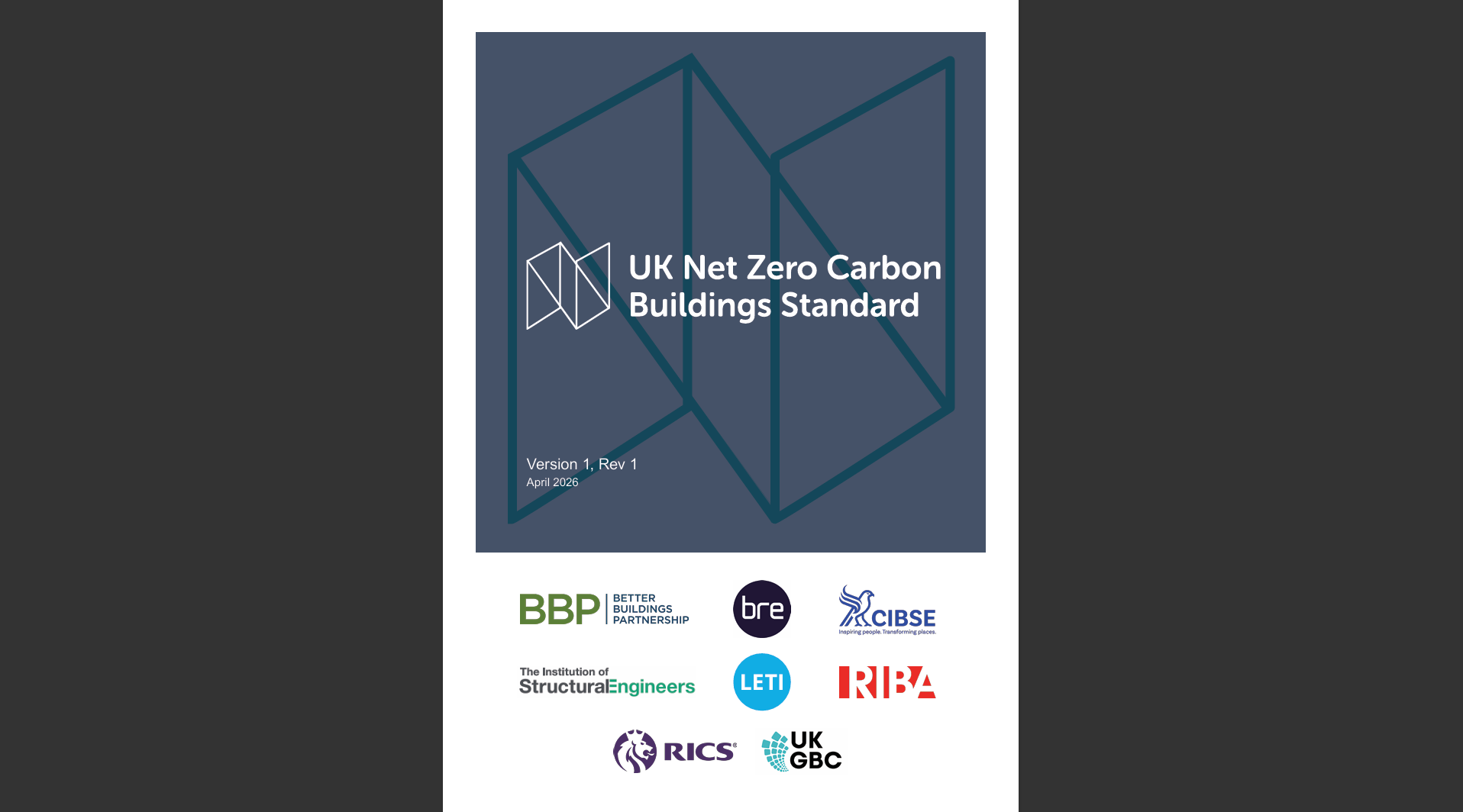
Picture: An image of the front page of the UK Net Zero Carbon Buildings Standard.
Article written by Dave Mapps | Published 06 August 2026
Commercial and public buildings risk being left behind in the UK's transition to net zero despite more than £40bn of funding, investment and policy support...
BRE Launches BREEAM Refurbishment And Fit Out Commercial Version 7
The Building Research Establishment (BRE) – an international building science centre – has launched BREEAM Refurbishment and Fit Out Commercial Version 7...
Willmott Dixon Lands £19.3m First Phase Of Coleg Gwent's Crosskeys Campus Transformation
Willmott Dixon has secured the £19.3 million first phase of Coleg Gwent's redevelopment of its Crosskeys Campus in Newport, transforming the site into a modern,...
Eighteen Light Emitting Diode (LED) upgrade projects have been successfully delivered during year two (August 2025 – July 2026) of Imperial's 17-year Net Zero...
Spotlight Interview – Chris Goggin | Rinnai – Part 1
In the first of this three-part mini-series ThisWeekinFM speaks to Chris Goggin, Director of Operations at Rinnai UK, the world’s largest manufacturer of gas...
The UK Net Zero Carbon Buildings Standard Performance Evaluations
A new designation will recognise buildings’ progress on the path to Net Zero Carbon Alignment. The UK Net Zero Carbon Buildings Standard (UK NZCBS) Performance...
Aston University Takes Major Step Towards Net Zero Goal
Work has started on Aston University’s Carbon Neutral Energy Centre which aims to transform how power is generated and used across the University.
It is the...
UK Net Zero Carbon Buildings Standard Recognises CIBSE NABERS UK Energy for Office Ratings
The NABERS UK Energy for Office ratings, certified by CIBSE and administered through its wholly owned subsidiary CIBSE Certification, may now meet the...
Dalkia Completes Decarbonisation Scheme at Arup’s London HQ
The £3.1 million scheme to decarbonise Arup’s headquarters at 8 Fitzroy Street is now complete.
Dalkia has delivered the validation, detailed coordination,...
UK Net Zero Carbon Buildings Standard Appoints Bureau Veritas for Administrator Role
Bureau Veritas has been appointed to help develop the verification framework and methodology for the first version of the UK Net Zero Carbon Buildings Standard.
For an...
Beyond SCOP - Estimating Real World Heat Pump Performance With SPF
Rinnai Applied Head of Design Sean Ehlen evaluates the importance of heat pump system congruity utilising Seasonal Performance Factors (SPF) as the expected performance. Click Image To Read More
Energy Transition Update
ThisWeekinFM Guest Editor, Daniel Lynn, has picked a number of examples that demonstrate an international energy transition across separate regions of the globe. Click Image To Read More
Boat Party 2026 Highlights
9 July 2026
400 FM professionals gather on the River Thames. Learn More Here >>
2027 Date announced soon.
Are Heat Pumps Really The Future?
Rinnai Director, Chris Goggin, looks at how heat pumps being classified as a main solution towards decarbonisation compares to the direction of the UK’s low carbon heating and hot water technology market. Click Image To Read More
Nationwide Air Conditioning Extends David Lloyd Contract
Their 15-year partnership extended to cover Ireland, over 115 clubs and over 10,000 assets. Click Image To Read More



.gif)

.gif)