
.gif)
.gif)

More Efficient Cooling Needed As UK Data Centre Demand Rises
As investment in UK data centres continues to gather pace, Pieter Swart, Head of Specification, Fire & Modular Systems at Grundfos, is urging operators to prioritise...
Read Full Article

The Leading News & Information Service For The Facilities, Workplace & Built Environment Community
Artificial intelligence (AI) is growing strongly across Europe, with AI clusters emerging in major office markets and smaller academic and specialist hubs, according to new research from Colliers.
The report, AI Clusters in Europe: Where AI companies are growing and what it means for office demand, identifies London, Paris and Berlin as Europe’s leading AI clusters, attracting talent, investment and business expansion. A second tier of hubs is emerging in Munich, Zürich, Amsterdam, Dublin, Stockholm, Warsaw, Barcelona and Helsinki, while other cities are developing increasingly specialised AI ecosystems. Beyond these established hubs, Madrid, Milan and Copenhagen are emerging as specialised AI clusters, building on local academic expertise and established technology and industrial strengths.
Colliers’ analysis of AI clusters in Europe finds that the most successful bring together four critical ingredients: government-led initiatives, strong startup ecosystems, universities and research institutions, and Big Tech laboratories. Substantial data centre capacity provides an increasingly important supporting foundation.
London and Paris are the only European AI clusters that currently combine all four ingredients at scale, supported by significant data centre capacity. Berlin has developed a different model, driven by its startup culture, engineering talent and distributed network of entrepreneurial and research-led districts.
The research also points to significant economic potential. AI is expected to increase European GDP by around 10% to 11% by 2030 through productivity gains, automation and the creation of new products and services. The EU’s strategic challenge is not primarily a lack of innovation, but its ability to commercialise research, attract investment and build globally competitive AI businesses.
The impact is already becoming visible in occupational markets. AI businesses are creating demand directly as they recruit and expand, while the adoption of AI is also driving transformation across existing office-based sectors.
The report identifies a new type of occupier: highly capitalised, exceptionally fast-growing AI businesses that recruit aggressively and can outgrow their premises within a relatively short period. Many initially use serviced or flexible offices before moving into larger permanent premises, making their full real estate footprint difficult to capture through conventional leasing data.
London provides the clearest current example. AI businesses accounted for 19% of total London office take-up in the second quarter of 2026, up from 10% in the previous quarter. Colliers notes that London may be an outlier in scale, but its experience illustrates the potential effect on other European markets as their AI clusters mature.
For investors and developers, the growth of AI brings both a demand opportunity and a product challenge. The report finds that the buildings best placed to attract AI occupiers are likely to combine strong locations, high-capacity digital and power infrastructure, flexible layouts, collaboration space and the ability to accommodate rapid growth.
Although AI’s long-term effect on employment and real estate remains uncertain, Colliers concludes that it is already reinforcing demand for high-quality offices and digital infrastructure in Europe’s most talent-rich cities.
Damian Harrington, Head of Research, Global Capital Markets & EMEA at Colliers, said: “AI is rapidly becoming an economic geography and real estate story. Its growth is reinforcing the importance of cities that can bring together specialist talent, research, capital, infrastructure and enterprise customers.”
Harrington added: “The implications extend well beyond the technology sector. The cities that develop successful AI ecosystems will be better placed to attract investment, create high-value employment and secure new sources of office demand.”
Karin Witalis, Associate Director, Commercial Real Estate, EMEA Research at Colliers, said: “AI businesses are not choosing locations on cost alone. Access to highly skilled people, universities, research institutions, venture capital and established technology networks is central to their decisions.”
Witalis continued: “This is helping to reinforce successful metropolitan ecosystems and the innovation districts within them. It also creates an opportunity for European cities with strong academic or specialist foundations to build distinctive positions within the wider AI economy.”
1. Colliers Research: AI Clusters in Europe – see here.
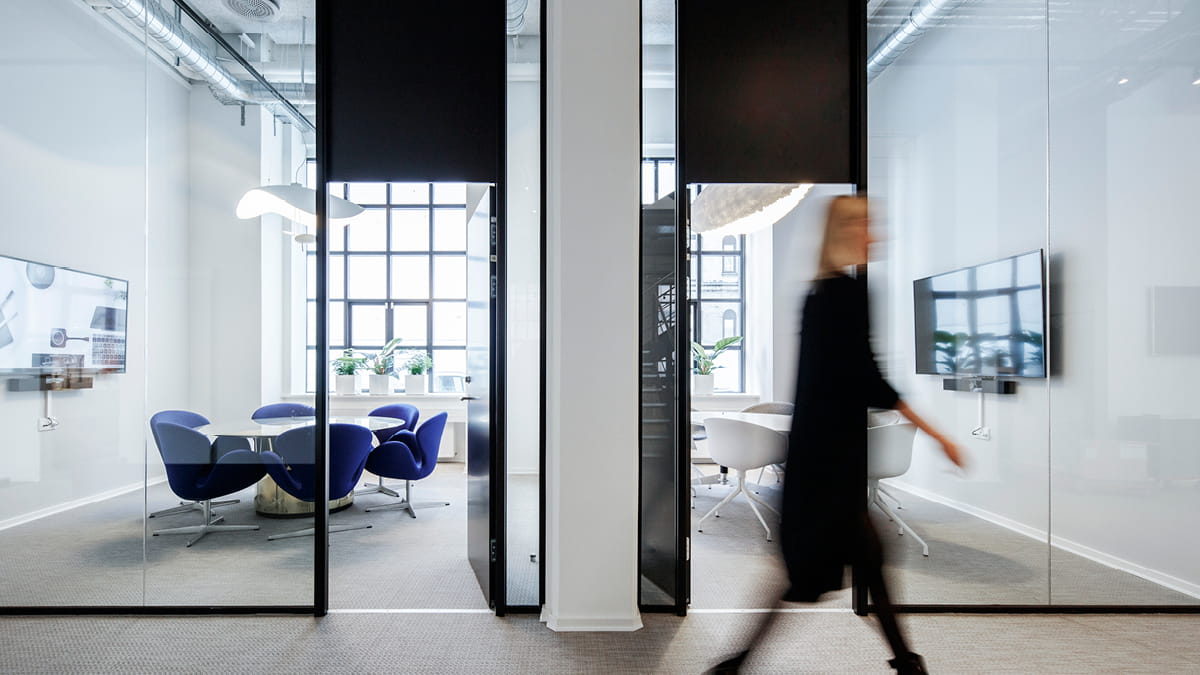
Picture: A motion-blurred figure walks past modern glass-walled meeting rooms.
Article written by Dave Mapps | Published 01 October 2026
As investment in UK data centres continues to gather pace, Pieter Swart, Head of Specification, Fire & Modular Systems at Grundfos, is urging operators to prioritise...
Read Full ArticleLondon's office stock scores well on cyber resilience – but digital readiness is quietly undermining asset values. William...
Read Full ArticleThe mechanical & electrical (M&E) contracting market has shown impressive resilience in the face of challenging economic conditions, according to a new Top 30 UK...
Read Full ArticleLolly, a provider of hospitality technology, has announced that SnapServe Pro, its new AI-powered tray-scanning solution, has entered live customer trials, marking a...
Read Full ArticleMike Talbot, Chief Technology Officer at SFG20, the industry standard for building maintenance, has shared his thoughts on technology adoption in the built sector and how...
Read Full ArticleDavid Axon, chairman of AirPlus Renewables, explains why the rapid growth of data centres is exposing the limits of a centralised energy system and why generating more...
Read Full ArticleNew analysis from Colliers, covering more than 200 global markets, shows how artificial intelligence, hybrid working and intensifying competition for talent are...
Read Full ArticleAn industry first in facilities management: where automation was designed not to replace people, but to set them free. Facilities management businesses rarely...
Read Full ArticleThe hype around AI in FM should not be allowed to obscure the essential human element, says Joss Rennocks, Transformation Director at Bellrock. AI is changing...
Read Full ArticleDemis Hassabis, CEO and Co-Founder at Google DeepMind discusses the completion of their most ambitious building to date, Platform 37, located in the heart of...
Read Full Article