David Axon, chairman of AirPlus Renewables, explains why the rapid growth of data centres is exposing the limits of a centralised energy system and why generating more electricity at the point of use must become part of the solution.
Every major AI announcement is followed by the same conversation. We talk about faster models, bigger investments and the industries that could be transformed. Much less attention is paid to the infrastructure quietly making all of that possible.
Every chatbot, image generator and AI-powered search relies on data centres running around the clock. Those facilities don't simply consume electricity. They need a constant, dependable supply of it, every hour of every day. As more data centres are built, their need for reliable energy is becoming impossible to ignore.
It's easy to assume this is simply a generation problem. Build more wind farms. Install more solar. Increase capacity and demand will take care of itself. I don't think it's that simple.
For decades we've built an energy system around a single assumption: electricity is generated in one place and transported to another. That model has served us well, but it also means every new source of demand places another burden on the same infrastructure. AI hasn't created that problem. It's simply making it much harder to overlook.
Bigger Grids Aren't The Only Answer
The UK is investing heavily in grid infrastructure because it has to. More renewable generation, electrified transport and the growth of AI all require a stronger network. However, the network is already struggling to keep pace. In some parts of the country, renewable electricity cannot always be accepted by the grid, meaning generators are paid to reduce output while consumers continue to fund investment in additional infrastructure. Nobody would argue against strengthening the grid, but the question is whether it should be expected to carry an ever-growing share of our energy demand.
If a business can produce some of its own electricity where it is consumed, that electricity doesn't need to travel hundreds of miles across the network. Scale that across thousands of commercial sites and the conversation changes. You're no longer asking how to move ever greater volumes of electricity around the country. You're asking where it makes most sense to generate it in the first place.
Data Centres Are Changing The Conversation
Data centres are often discussed as if they're a unique challenge, but they're really a sign of something much bigger. Hospitals, factories, logistics hubs and transport infrastructure are all becoming more digital. They're processing more information, relying on more connected equipment and placing greater demands on electricity than they did ten years ago. AI just happens to be accelerating the trend.
That means energy resilience is becoming as important as energy efficiency. Organisations aren't only looking at how much electricity they consume. They're asking where it comes from, how exposed they are to the grid and whether there are practical ways to generate more of it themselves.
Looking Beyond Solar
Solar has transformed on-site renewable generation. It deserves enormous credit for that. It has also demonstrated that businesses are willing to invest in technologies that reduce reliance on imported electricity. There is no reason that conversation should stop with solar.
Wind has often been dismissed in built environments because traditional turbines were designed for open landscapes rather than the complex airflow found around buildings. That's left a significant source of renewable energy largely untapped.
Technology allows us to approach the challenge differently. It can be designed to make use of airflow that conventional systems tend to ignore, including the turbulent conditions commonly found around commercial buildings and infrastructure.
Rather than treating the turbulent airflow around buildings as something to avoid, Technology has been developed to make use of it. Conventional small wind turbines have typically been designed for smooth, uninterrupted wind found in open spaces, limiting their effectiveness in urban and industrial environments. Now technology, like EDGEWIND™️ Tech, can capture both turbulent and non-turbulent airflow to generate electricity closer to where it is consumed.
This can be taken further. XEVA® for example, applies this principle in a compact, modular system that can be installed on commercial buildings and other constrained sites, complementing existing renewable technologies such as rooftop solar rather than replacing them.
I don't see decentralised wind as an alternative to large wind farms or the national grid. It fills a different role. By generating electricity at the point of use, technologies such as XEVA® reduce dependence on grid infrastructure, which is becoming increasingly constrained and increasingly expensive to expand. The less electricity that needs to be transported across the network, the less pressure there is on a system that is already struggling to accommodate growing demand.
A Different Way Of Thinking
The growth of AI is forcing us to rethink more than computing power. It's prompting a wider conversation about how electricity is generated and distributed.
The question is whether every new electricity demand should be met by asking more of the same network, or whether some of that demand could be met much closer to the point of use.
For me, that's where the real opportunity lies. Data centres may have brought the issue into focus, but the lesson stretches much further. The businesses that build greater resilience into their energy supply today will be better prepared for whatever comes next.
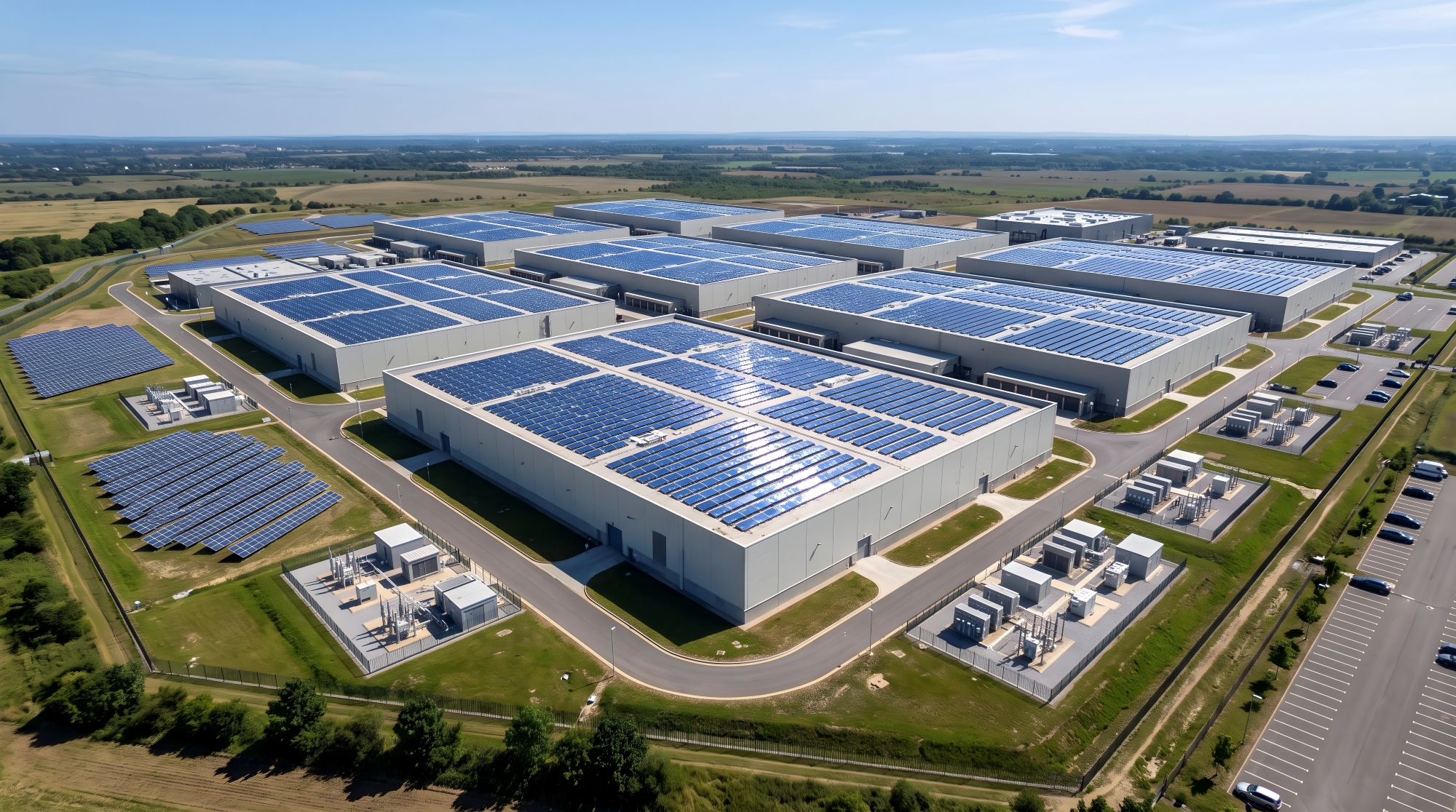
Picture: An aerial image of a data centre.
Article written by David Axon | Published 08 September 2026
AI Clusters Expand Across Europe In New Wave Of Office Demand
Artificial intelligence (AI) is growing strongly across Europe, with AI clusters emerging in major office markets and smaller academic and specialist hubs, according to...
More Efficient Cooling Needed As UK Data Centre Demand Rises
As investment in UK data centres continues to gather pace, Pieter Swart, Head of Specification, Fire & Modular Systems at Grundfos, is urging operators to prioritise...
Datore is a business intelligence platform that provides visual analytics and AI solutions to allow companies to optimise their energy usage and sustainability...
EcoSync Close to £1m Funding Target for Commercial Building Energy Solution
A tech start-up that provides room-by-room energy management solutions for commercial buildings has raised close to £1 million in its second seed funding...
ZTP uses artificial intelligence-led risk modelling software to help predict UK electricity and gas market price movements.
As an energy consultancy and...
Merton Council – Why We Chose AI to Cut Energy Waste
The London borough of Merton has identified energy waste valued at £25,000 using a new artificial intelligence tool.
The council turned to AI to make sense...
BCIS Reveals Updated Five-Year Maintenance, Cleaning And Energy Forecast
Maintenance costs, as measured by the BCIS All-in Maintenance Cost Indices – General index, are forecast to rise by 15.3% over the five years to 2Q2031, according...
BRE has revealed the winners of its annual BREEAM Awards 2026 - a celebration of the projects, organisations and people leading the way in sustainable building design,...
The mechanical & electrical (M&E) contracting market has shown impressive resilience in the face of challenging economic conditions, according to a new Top 30 UK...
New Analysis Warns Of Biggest Energy Cost Surge Of The Decade
Businesses are calling on the UK government to reconsider its Clean Power 2030 target due to concerns about the cost impact of delivering the transition, according to...
Beyond SCOP - Estimating Real World Heat Pump Performance With SPF
Rinnai Applied Head of Design Sean Ehlen evaluates the importance of heat pump system congruity utilising Seasonal Performance Factors (SPF) as the expected performance. Click Image To Read More
Energy Transition Update
TThisWeekinFM Guest Editor, Daniel Lynn, has picked a number of examples that demonstrate an international energy transition across separate regions of the globe. Click Image To Read More
Rinnai Director, Chris Goggin, looks at how heat pumps being classified as a main solution towards decarbonisation compares to the direction of the UK’s low carbon heating and hot water technology market. Click Image To Read More
Nationwide Air Conditioning Extends David Lloyd Contract
Their 15-year partnership extended to cover Ireland, over 115 clubs and over 10,000 assets. Click Image To Read More
Boat Party 2026 Highlights
9 July 2026
400 FM professionals gather on the River Thames. Learn More Here >>
2027 Date announced soon.
Risk Now A Critical Piping System Specification
James Griffiths, Head of Projects at GF Building Flow Solutions, explores how pipe theft forces industry to reconsider long-established specification decisions. Click Image To Read More

.gif)
.gif)