.gif)


.gif)
What Does Gen Z Want From an Office Space?
Generation Z currently makes up 30 per cent of the world’s population and will account for 27 per cent of the workforce by 2025 – so what are their...
Read Full Article

The Leading News & Information Service For The Facilities, Workplace & Built Environment Community
As the workplace continues to evolve with new norms and expectations, the question remains: will Gen Z adjust, or be the ones reshaping it?
Paul Sherwin from office design company Oktra explains how facilities managers can create workspaces that genuinely meet the needs of a younger generation of workers.
Paul is Managing Director at Oktra with over twenty fiive years of industry experience and a deep understanding of the entire design and build process. His previous roles include Senior Designer for Morgan Lovell and Design Director at Maris Interiors LLP.
Having spent their formative years in isolation, many Gen Z view the workplace as an opportunity to create new, meaningful interactions in both social and professional settings. While some narratives paint Gen Z as eager to return to physical offices for social interaction, others emphasise their preference for flexibility and remote work.
But amid these contrasting views, one truth stands out: the office must continue to evolve. It can no longer function solely as a place for task completion and metrics. It needs to become a dynamic environment that fosters growth, wellbeing, and a strong sense of purpose for the newest generation of professionals.
To encourage Gen Z’s growth and attract top future talent, businesses should focus on creating workspaces that genuinely meet the needs of the younger generation of workers. Primarily, Gen Z value social connections and relationships, so facilities managers and business leaders should consider employing “Town Hall” style layouts like communal bars or kitchen islands to eat together, shared lounges and conjoined desks.
.jpg)
Picture: a photograph showing three people sitting on tiered town hall-style seating. One person is using a laptop, another person is on the phone, and someone else is reading. Image Credit: Oktra
These intentional choices in design and function not only encourage spontaneous conversations but also support career growth by creating spaces for collaboration and learning from senior members. This is especially crucial for Gen Z, many of whom began their education or careers remotely and missed out on the in-person mentorship, informal learning, and workplace culture that older generations enjoyed. Thoughtfully designed office spaces can help bridge that gap, offering the kind of real-time development and connection that remote setups struggle to replicate.
Additionally, the rise of hybrid work has driven a demand for greater flexibility and agility in the workplace, and many young professionals encountered these changes as they entered the workforce for the first time. Their academic and social development has so far been rooted in the online world - exams taken from bedrooms, lectures streamed remotely, and friendships maintained via group chats and video calls. Gen Z now expect their workplace to follow in tandem, accommodating to, when, where and how they work. Multi-modal work zones are a great way to accommodate a variety of working styles and meet this demand for flexibility. Think collaborative open areas, casual lounges, standing desks, and incubated pods for calls or deep work.
What was once limited to a few token plants dispersed in the office, biophilic design has now evolved into a fully integrated philosophy that’s increasingly relevant in today’s workplaces. Gen Z is a generation that values wellbeing, sustainability, and intentionality, and biophilic spaces go beyond just aesthetic appeal. Natural elements like greenery, organic materials, and nature-inspired layouts have been shown to reduce stress, boost mood, and enhance focus – all of which contribute to a healthier, more inviting work environment for Gen Z and all workers. Today’s office should embrace nature in more creative, immersive ways - this could include ‘living walls’ that embed greenery into the built-in environment, calming water features like fountains in communal areas and plenty of natural light. In a world where younger workers are seeking more than just a desk, incorporating biophilic principles can make the office less of an obligation, and more of a space that promotes comfort.

Picture: a photograph of Paul Sherwin. Image Credit: Oktra
Some businesses have also embraced “Work from Anywhere” policies, allowing employees to treat the world as their office - a shift that’s reshaping the role of the physical workspace and even resulting in companies downsizing. In response to this, facilities managers must adapt and reevaluate how and when the office is used - repurposing the space for creative and social functions when it is underutilised.
A well-designed office doesn’t just look good. It sends a message: you belong here. For Gen Z, this sense of safety is essential for their wellbeing. Young people care about accessibility and inclusion, and offices can start to include design features that accommodate these needs. This might involve offering dimmable lighting and sensory-friendly zones for neurodivergent individuals, providing adjustable desks, and ensuring spaces are accessible for all mobility levels. Successful office design should reform the workplace to support Gen Z’s mental and physical wellbeing - with additions such as natural light, plenty of indoor plants, wellness rooms, outdoor space, ergonomic furniture, and ventilation systems for a healthy air circulation.
Optimised office design can build a great culture for Gen Z to thrive in, as they often want to feel part of something bigger. Facilities teams play a key role in making this tangible by integrating company culture into the physical space. This might include curated artwork that reflects company identity or values, cohesive colour schemes, branded signage that reinforces a sense of belonging, and community boards that spotlight internal initiatives or employee achievements. Purpose-built event spaces for workshops, talks, or social gatherings also help reinforce connection and company ethos. Done well, these design touches transform the workplace into more just than a functional setting - it can be somewhere that Gen Z are proud to work in.
Businesses have a responsibility to reimagine the office for the younger generation, creating opportunities for connection, career growth, and the kind of work that means something to Gen Z. From desk layout and simple lighting, to bespoke furnishings, every design choice sends a message. If the workplace is thoughtfully designed to support how Gen Z works and lives today, it sets the stage for workers of the future.
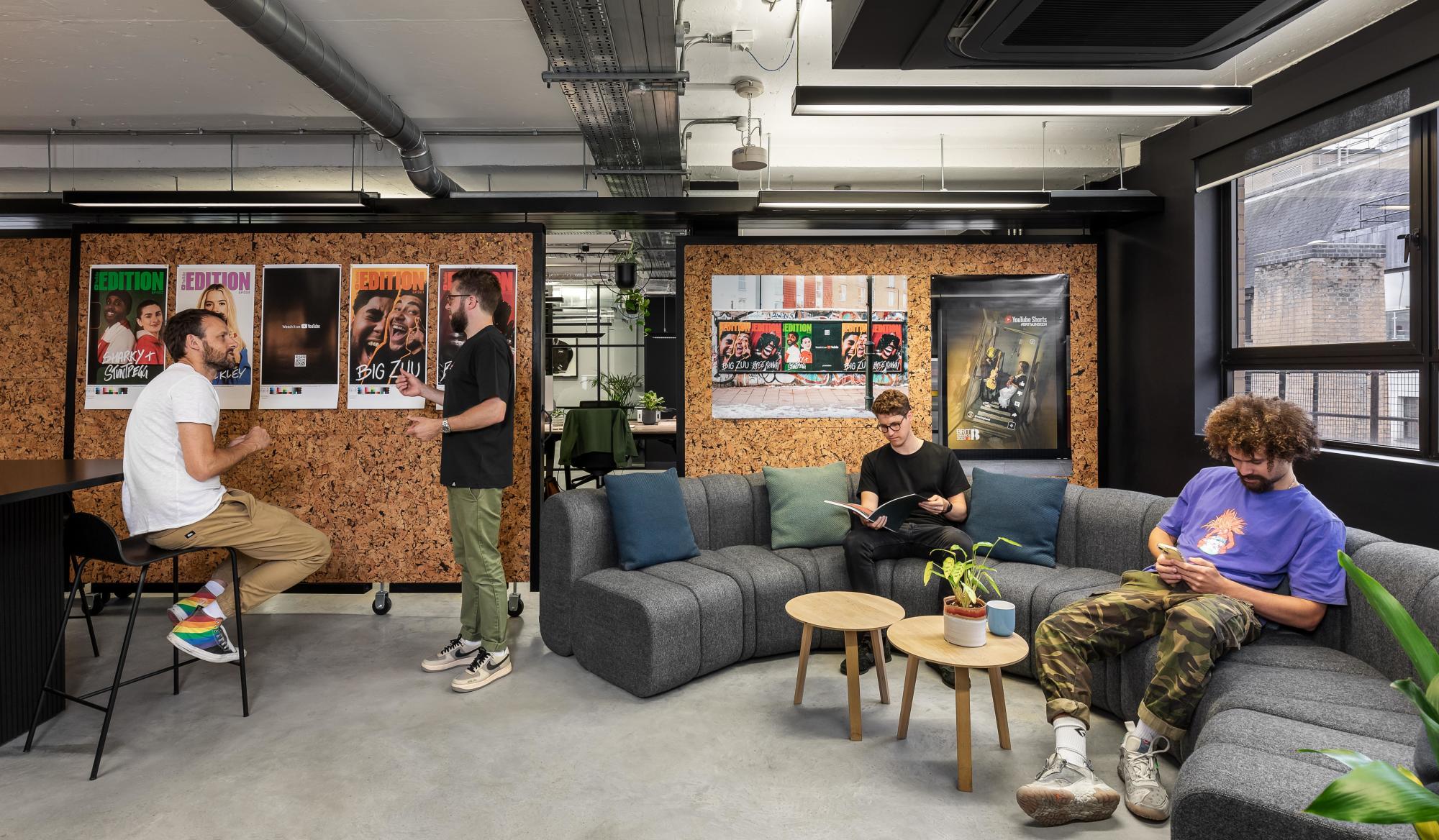
Picture: a photograph showing four people in a modern workspace with corkboard walls and a circular sofa. Two people are seated on the sofa, one reading and one using their phone. A third person is seated on a high stool, speaking to a fourth person who is standing. Image Credit: Oktra
Article written by Paul Sherwin | Published 28 October 2025
Generation Z currently makes up 30 per cent of the world’s population and will account for 27 per cent of the workforce by 2025 – so what are their...
Read Full ArticleSimon Barnes, Vice President Sales and Marketing, ABM UK & Ireland, highlights that contrary to assumptions, Gen Z spends the most days in the office seeking...
Read Full ArticleData from the Institute for Public Policy Research shows that one in three Gen Z workers feels pressured to drink alcohol at work parties. Additionally, 24 per cent...
Read Full ArticleGlobal travel brand Skyscanner has a new Edinburgh hub in the heart of Quartermile. The new office spans two floors and 25,000 sq ft of space, and has been completely...
Read Full ArticleMute's new headquarters in Poland is Europe's first office built entirely using a modular system. The project showcases how modular office systems can reduce...
Read Full ArticleA guide to help facilities managers create workspaces for the hybrid working generation has been published by the British Council for Offices. The BCO’s flagship...
Read Full ArticleA survey of 2,000 UK employers shows that just one in four employers recruiting young people think they are well-prepared for the world of work. 52 per cent...
Read Full ArticleBW: Workplace Experts has completed the major fit-out of Virgin Media O2’s London headquarters in Paddington, marking the first office space investment since the...
Read Full ArticleTravel search engine Skyscanner’s London office has been refurbished by BW: Workplace Experts. The company occupies two floors of the Ilona Rose building in Soho...
Read Full ArticleA new office building in Southampton Port has been constructed entirely out of converted shipping containers, saving around 40 per cent against the cost of a traditional...
Read Full Article