.gif)

.gif)
Infogrid Acquires Aquicore to Strengthen ESG Reporting Offering
UK smart building technology firm Infogrid has announced the acquisition of Aquicore, an ESG data and analytics company. The acquisition will merge...
Read Full Article

The Leading News & Information Service For The Facilities, Workplace & Built Environment Community
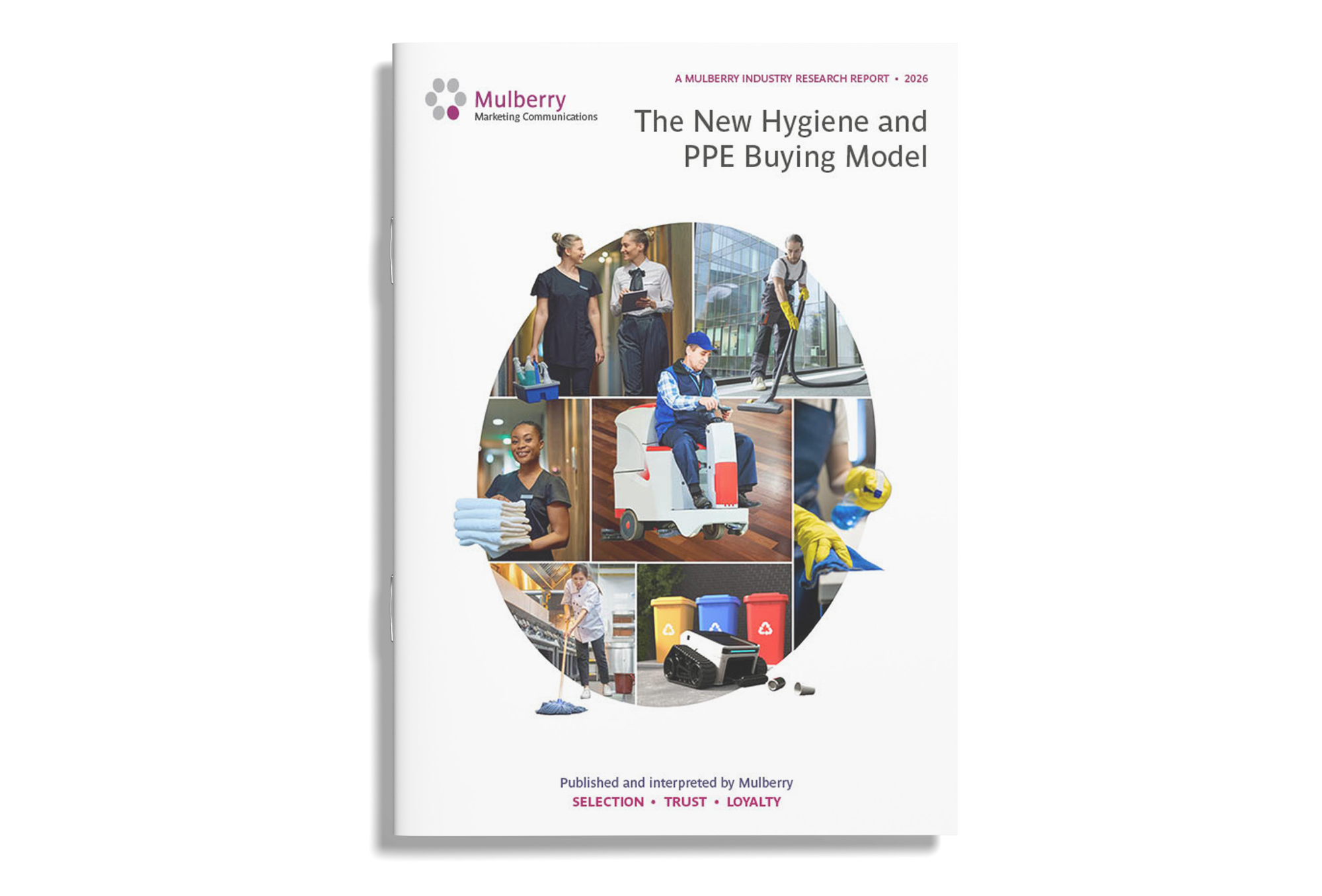
New international research from Mulberry Marketing Communications has revealed that professional hygiene buyers are demanding more from their suppliers - combining traditional expectations of value and reliability with growing demands for transparency, credible sustainability evidence and consistent communication.
The New Hygiene Buying Model: What influences supplier selection, trust and loyalty in the professional hygiene industry is based on responses from 1,320 professionals working across health, hygiene and facilities management in the UK, European Union, non-EU Europe and North America.
The report finds that value for money remains the leading consideration when selecting a supplier, identified as a top-three priority by 71% of respondents. Reliability follows at 59%, with customer service selected by 43%.
However, the findings suggest that buyers are looking beyond initial price to consider the broader cost and operational impact of supplier performance. Product availability, service continuity, responsiveness, equipment uptime and the ability to reduce operational risk can all influence perceptions of value.
Sustainability Matters - But Must Demonstrate Value
Nearly three-quarters of respondents - 74% - say a supplier’s sustainability strategy is important when making selection or procurement decisions. Yet only 25% place sustainability or ESG alignment among their three leading supplier-selection priorities.
Mulberry believes this apparent tension shows that sustainability has become an expected component of a credible hygiene proposition, rather than a standalone reason to choose a supplier.
Environmental benefits are likely to carry greater commercial weight when connected to tangible outcomes such as reduced energy or water use, lower consumption, less waste, longer product life, safer processes and lower total cost.
Buyers are Asking Suppliers to Prove Their Claims
The research also identifies a growing demand for evidence. When respondents were asked how a supplier could demonstrate that it was credible and responsible:
The report concludes that unsupported sustainability claims are becoming less persuasive. Hygiene brands increasingly need a connected evidence system combining certification, measurement, transparent reporting and real customer outcomes.
Consistent Delivery is the Leading Driver of Loyalty
Consistent service delivery was identified as the strongest potential driver of increased supplier loyalty, selected by 41% of respondents.
Other important loyalty drivers include greater transparency around ESG impact and certification at 37%, more innovative solutions at 34%, lower prices at 33%, and improved communication and reporting at 30%.
The survey’s open responses reinforce the importance of communication. Buyers repeatedly called for clearer updates, quicker answers, improved delivery information and easier access to certification, audit findings and sustainability data.
The report argues that communication should be treated as an integral part of service delivery rather than an activity that takes place around it.
AI is Entering the Supplier Research Process
The findings also point to a significant change in how suppliers are discovered and evaluated. Seventy-eight per cent of respondents use at least one of the listed AI-powered platforms or tools when researching suppliers or potential partners.
ChatGPT is used by 59% of respondents, followed by Gemini at 39% and Microsoft Copilot at 36%.
Mulberry warns that hygiene brands are no longer competing for visibility solely through conventional search engines, trade media, distributors and procurement channels. They increasingly need authoritative, clearly structured and independently supported information that can be found, interpreted and referenced by AI platforms.
The report introduces a new three-stage framework for understanding the supplier relationship:
Matthew Howells, International Director at Mulberry, said: “The research shows that hygiene buyers are not choosing between value, performance and responsibility - they increasingly expect suppliers to deliver all three.”
Howells continued: “Price will always matter, but buyers are taking a broader view of value. They want dependable performance, clear communication and evidence they can trust and defend internally. For hygiene brands, the opportunity is to make their value easier to understand, their claims easier to verify and their customer relationships easier to maintain.”
Howells concluded: “This report establishes the first benchmark in what will become an ongoing Mulberry research series. By tracking the findings over time, we will be able to see how buyer priorities evolve and help hygiene brands respond to the changes that genuinely influence selection and loyalty.”
Picture: An image of the New Hygiene and PPE Buying Model Report from Mulberry Marketing Communications.
Article written by Dave Mapps | Published 24 August 2026
UK smart building technology firm Infogrid has announced the acquisition of Aquicore, an ESG data and analytics company. The acquisition will merge...
Read Full ArticleApplying AI methodologies to improve diversity in business is just one of the themes explored in a new business guide to AI. Authored by AI thought-leader and advisor...
Read Full ArticleArtificial intelligence (AI) is growing strongly across Europe, with AI clusters emerging in major office markets and smaller academic and specialist hubs, according to...
Read Full ArticleProfessionals from the cleaning and hygiene sector celebrated success after winners were revealed at this year’s BICSc Awards. The industry-leading awards highlight...
Read Full ArticleLolly, a provider of hospitality technology, has announced that SnapServe Pro, its new AI-powered tray-scanning solution, has entered live customer trials, marking a...
Read Full ArticleMike Talbot, Chief Technology Officer at SFG20, the industry standard for building maintenance, has shared his thoughts on technology adoption in the built sector and how...
Read Full ArticleAs investment in UK data centres continues to gather pace, Pieter Swart, Head of Specification, Fire & Modular Systems at Grundfos, is urging operators to prioritise...
Read Full ArticleWayne Rose, Chief Executive at the British Pump Manufacturers Association (BPMA) looks at how digitalisation is rapidly reshaping the UK pump industry, moving it beyond...
Read Full ArticleDavid Axon, chairman of AirPlus Renewables, explains why the rapid growth of data centres is exposing the limits of a centralised energy system and why generating more...
Read Full ArticleGlobal operations system SafetyCulture is celebrating 10 years of business in the UK with the biggest transformation in its history, including a rebrand and new AI...
Read Full Article