.gif)


.gif)
British Safety Industry Federation Warns Against Fake PPE
The British Safety Industry Federation is urging anyone seeking offers of PPE to check the validity of any products and their certification before using...
Read Full Article.png)

The Leading News & Information Service For The Facilities, Workplace & Built Environment Community
The relaunch of the British Safety Industry Federation's (BSIF) Clean Air? Take Care! campaign1 comes at an important time for occupational health, explains John Hooker, Chief Executive Officer at the British Safety Industry Federation.
Despite significant advances in workplace safety, occupational respiratory disease remains one of the UK's greatest causes of work-related ill health. The Health and Safety Executive (HSE) estimates2 that around 11,000 people die each year from occupational lung disease linked to past workplace exposures, while around 22,000 workers develop breathing or lung problems caused or made worse by work annually.
While asbestos continues to account for many of these deaths, today's workforce faces a new generation of respiratory hazards. Respirable crystalline silica (RCS), generated during activities such as cutting concrete, drilling masonry, quarrying, tunnelling and working with engineered stone, is now recognised by HSE as one of the most significant respiratory risks facing the construction industry. Exposure to silica dust can lead to silicosis, chronic obstructive pulmonary disease (COPD) and lung cancer, yet the dust itself is often invisible, making it easy to underestimate the danger.
The challenge is that many occupational respiratory diseases have latency periods measured in decades. The statistics we see today often reflect exposures that occurred many years ago, meaning the impact of the decisions we make today may not become fully apparent for a generation. That makes continuous improvement essential. Every step taken to improve awareness, competence and communication has the potential to reduce future disease.
Making Respiratory Protection Count
For BSIF, the priority has always been helping employers and wearers ensure that when respiratory protective equipment (RPE) is required, it delivers the protection it is designed to provide.
Modern respirators are capable of providing exceptionally high levels of protection, but only when they are appropriate for the hazard, fit the wearer correctly and are used as intended. Too often, failures in respiratory protection are not caused by the product itself, but by inappropriate product selection, poor face fit, inadequate training or incorrect use.
Helping employers understand these requirements, and giving wearers the confidence to use RPE correctly, has been central to BSIF's work for many years. That philosophy underpins the refreshed Clean Air? Take Care! campaign.
Originally launched 15 years ago, the campaign was created to promote good practice in respiratory protection. Its core message remains as relevant today as it was then: selecting the right equipment is only the first step. Ensuring it is correctly fitted, properly maintained and used correctly is what ultimately protects workers from hazardous airborne contaminants.
Reaching People Where They Work
The latest refresh of Clean Air? Take Care! recognises that while the principles of respiratory protection remain the same, the way people access information has changed.
Health and safety information is becoming increasingly digital. Online resources are easier to update, can provide greater depth and are available whenever they are needed. However, in the drive to digitalise, we should not lose sight of the value of well-designed printed guidance.
Many of the people who rely on respiratory protection every day work on construction sites, in workshops, factories and engineering environments. They are focused on the job in hand rather than sitting behind a desk. For them, simple, visual guidance that can be kept in a pocket, toolbox or site office remain an effective way of reinforcing key messages at the point of use.
That thinking influenced the development of the campaign's new printed guide. It distils the essential principles of respiratory protection into an easy-to-follow visual format that workers can refer to quickly throughout the working day. QR codes then provide direct access to more detailed online guidance for those who want to explore specific topics in greater depth.
The aim is simple: get the right information into the hands of the people who need it, at the moment they need it.
Supporting Better Decisions
Providing practical guidance is only one part of helping employers improve respiratory protection.
Through its Duty Holder Membership scheme, BSIF supports employers, health and safety professionals, procurement specialists and others with responsibility for selecting and managing PPE. Members have access to expert advice, technical guidance, webinars, qualifications and the BSIF PPE Helpline, helping them navigate changing legislation, understand relevant standards and make informed decisions about protecting their workforce.
This sits alongside BSIF's wider work to raise occupational health and safety standards across industry. The Fit2Fit accreditation scheme3 has helped establish competence in face fit testing as an integral part of effective respiratory protection and is now attracting growing international interest. BSIF's collaboration with HSE on the updated FaceFit Respirator Demonstrator (FFRED) video has also provided employers and wearers with a practical demonstration of why achieving an effective face seal is fundamental to respiratory protection.
Although each initiative addresses a different aspect of respiratory protection, they all share the same objective which is to improve understanding, increase competence and help employers ensure that respiratory protective equipment performs as intended.
Investing In The Future
The UK has developed an international reputation for its approach to respiratory protection through collaboration between regulators, manufacturers, distributors and safety professionals. Maintaining that position depends on continuing to share knowledge, improve competence and provide practical support for those responsible for protecting workers.
Whether the risk comes from silica dust, welding fume, wood dust or other hazardous airborne contaminants, the objective remains the same: ensuring every worker who relies on respiratory protective equipment has the right product, correctly selected, correctly fitted and used correctly.
Occupational respiratory disease remains one of the UK's most significant workplace health challenges, but it is also one of the most preventable. The statistics that demonstrate the success of today's efforts may not be available for many years. That should never prevent us from acting today.
Every employer who strengthens their respiratory protection programme, every duty holder who is better equipped to make informed decisions and every worker who understands how to protect themselves contributes to healthier working lives for future generations.
1. The British Safety Industry Federation's Clean Air? Take Care! Campaign – see here.
2. The Health and Safety Executive (HSE) estimates – see here.
3. The Fit2Fit accreditation scheme – see here.
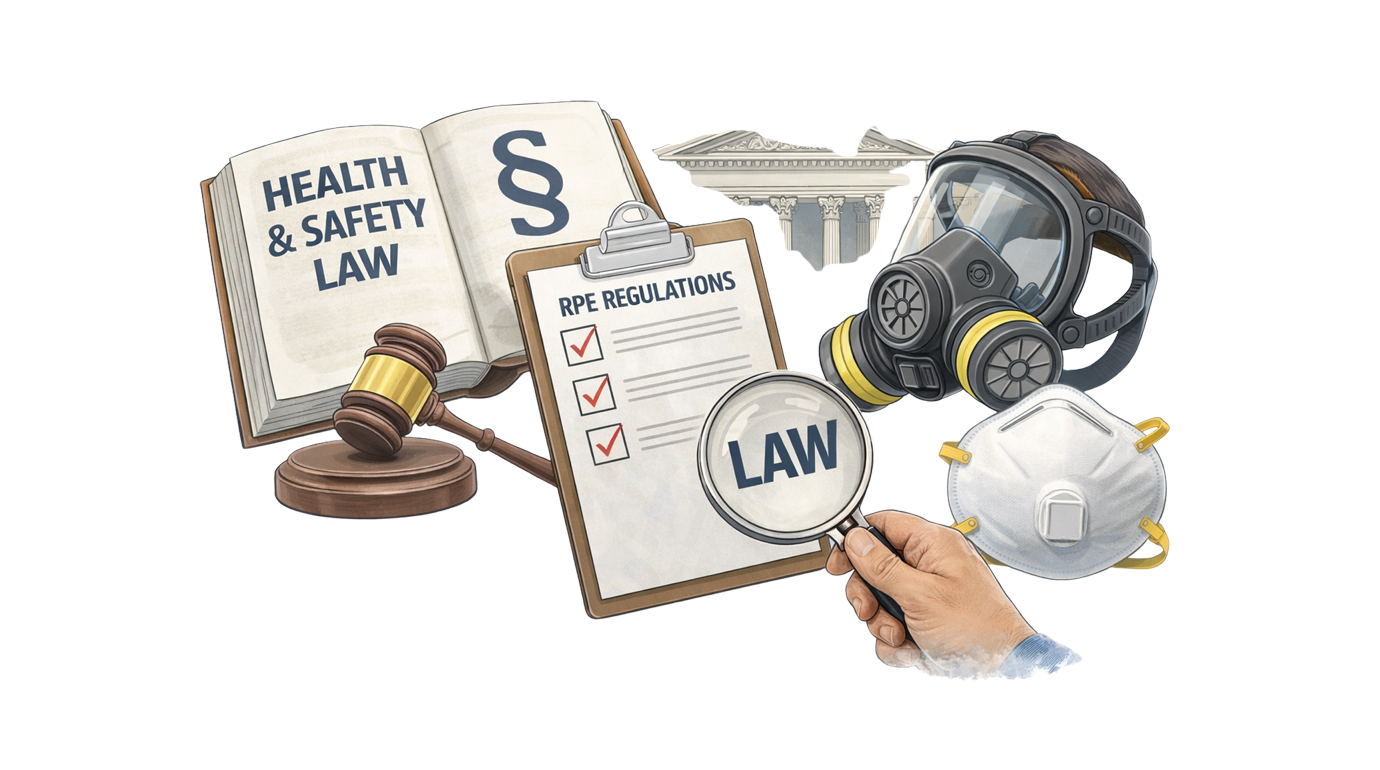
Picture: An image featuring elements related to respiratory protection compliance, including a " LAW" book, an "RPE REGULATIONS” checklist and two respirator masks.
Article written by Dave Mapps | Published 01 September 2026
The British Safety Industry Federation is urging anyone seeking offers of PPE to check the validity of any products and their certification before using...
Read Full ArticleSafety shoes sold on TikTok have been recalled following enforcement action by the Office for Product Safety and Standards. The shoes were listed under multiple...
Read Full ArticleAlan Murray, the CEO of the British Safety Industry Federation, was presented with the Lifetime Achievement Award at the Safety & Health Excellence Awards...
Read Full ArticleSafety testing has revealed an alarming amount of substandard and potentially hazardous PPE in Britain. The British Safety Industry Federation tested 161 products from...
Read Full ArticleThe British Safety Industry Federation is urging those responsible for procuring and specifying safety footwear to be aware of non-compliant items for sale in the...
Read Full ArticleThe government has confirmed the indefinite extension of the use of CE marking for UK businesses, but some are calling for extra clarity. What is the...
Read Full ArticleThe British Safety Industry Federation has published a checklist to help users check whether personal protective equipment is up to standard. Recent research from the...
Read Full ArticleMusculoskeletal disorders affect one in four of us, and selecting the right safety footwear can significantly reduce the risk. Simon Ash, UK Sales Manager at...
Read Full ArticleMore than one in ten workers suffer from occupational dermatitis, potentially exacerbated by PPE being worn for long periods and hand sanitiser use. UK PPE supplier...
Read Full ArticleStannah Lifts is highlighting the need to enhance workplace safety as the latest data from the Health and Safety Executive (HSE) shows that manual handling remains...
Read Full Article