.gif)

.gif)


Sodexo Renews And Expands Partnership With Transport For London
Sodexo UK & Ireland has announced it has renewed and expanded its contract with Transport for London (TfL) for a further three years, with an option to extend an...
Read Full Article

The Leading News & Information Service For The Facilities, Workplace & Built Environment Community
Transport for London (TfL) has unveiled its updated Corporate Environment Plan1, which sets out how TfL will continue to take action to improve air quality, reduce carbon emissions, adapt to climate change, enhance biodiversity, and use resources more sustainably across one of the world's largest integrated transport networks.
As one of London’s largest landowners and the city’s integrated transport authority, TfL has a unique role to play in tackling the challenges facing the capital, from the climate emergency to decarbonisation. This includes TfL establishing one of the first private wire schemes for an urban transport network, which will see it receive zero-carbon electricity straight from new solar installations, and running the largest zero-emission bus fleet in Western Europe, which now has more than 3,000 buses, from just 30 electric buses in 2016.
By enabling customers to choose more sustainable ways to travel, whether that’s by public transport, walking or cycling, or supporting drivers to switch to cleaner vehicles - with London having the largest electric vehicle (EV) charging network in the UK, TfL is also making it easier for everyone to play their part.
Building on the successes since the Corporate Environment Plan was first published in 2021, the updated 2026 plan supports the Mayor's vision for a thriving London, where more journeys are made by walking, cycling and public transport, while also helping deliver a more resilient and reliable network in the face of the climate emergency.
It contains more than 70 actions, which cover how TfL will achieve both its strategic ambitions, such as embedding circular economy principles into procurement and project delivery, and tangible outcomes, such as converting more lighting across London Underground to LED (Light Emitting Diode) lighting.
Key actions also include how TfL is adapting to climate change, with extreme weather events becoming more frequent, and protecting and enhancing green infrastructure, which can help provide shade and shelter alongside supporting biodiversity and increasing public health and wellbeing. These include:
Actions like this will help TfL still run a safe and reliable service, complementing other measures, such as the introduction of the new Piccadilly line trains, which will be air-conditioned and more energy efficient. The updated plan also includes how TfL will take further steps to decarbonise the transport network, propelling the capital towards net zero, including:
First published in 2021, the refreshed Corporate Environment Plan also reflects on what has already been achieved in the last five years, with future work building on these successes. Alongside more than 3,000 zero-emission buses now operating in London, these include:
Lilli Matson, Chief Safety, Health and Environment Officer at TfL, said: “We know that our city needs to be more sustainable and climate-resilient to continue being a fantastic place to live, work and travel. The impact of the climate emergency is becoming increasingly apparent and we need to work together at pace to take the action that’s needed to adapt our city and network, mitigating any risks.”
Matson continued: “Since first publishing our Corporate Environment plan five years ago, we’ve already implemented a variety of measures that have had a demonstrable impact, such as transitioning more than a third of our bus fleet to zero emission.”
Matson added: “We are committed to being transparent with our ambitions and achievements and this updated plan clarifies our next steps in making London and its transport services resilient and thriving for generations to come.”
Mete Coban, Deputy Mayor of London for Environment and Energy, said: “The climate crisis is on our doorstep, and is already disrupting vital services and costing our economy hundreds of millions of pounds.”
Coban continued: “That is why it is encouraging to see TfL unveiling its updated Corporate Environment Plan, setting out further action to improve air quality, reduce carbon emissions and adapt to climate change.”
Coban added: “The Mayor and I will continue to work with TfL to deliver more resilient, reliable and sustainable transport services across London as we build a greener, more sustainable capital for everyone.”
1. TfL’s Corporate Environment Plan – see here.
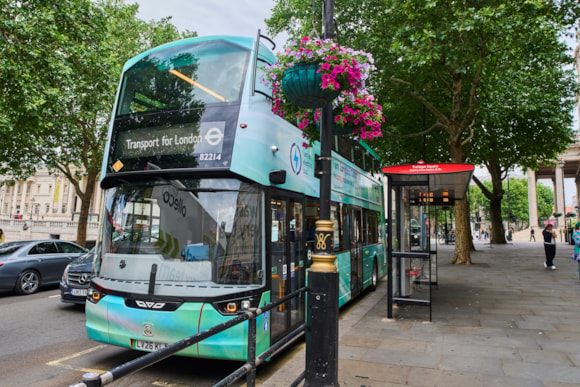
Picture: An image of a Transport for London electric bus parked at a bus stop in London.
Article written by Dave Mapps | Published 17 September 2026
Sodexo UK & Ireland has announced it has renewed and expanded its contract with Transport for London (TfL) for a further three years, with an option to extend an...
Read Full ArticleThe Mayor of London, Sadiq Khan, re-opened the Bank branch of the Northern line on Monday 16 May, following a 17-week planned closure. The closure enabled around 550...
Read Full ArticleApplications are now open for the latest Department for Education (DfE) SuDS in Schools grant scheme. Choosing the right supplier can help ensure such projects meet...
Read Full Article22 September 2023 marks World Car Free Day, and London’s neighbourhoods will be open for several events that involve leaving the car at home. World Car Free Day...
Read Full ArticleOn the eve of the extension of London’s Ultra Low Emission Zone (ULEZ) on 25 October, new data suggests not all businesses are ready, or are even aware of all the...
Read Full ArticleLast month was National Clean Air Month in the US. Why is air quality important? The pandemic has brought consideration of clean air to the public eye, but the quality...
Read Full ArticleA company best known for its pressure washers in the UK has taken a huge step in increasing environmental performance by deploying 967 solar panels on its HQ...
Read Full Article1 Broadgate is more than a flagship office; it's a living example of the strategies, frameworks, and partnerships JLL bring to their clients every day. This article...
Read Full ArticleBRE has revealed the winners of its annual BREEAM Awards 2026 - a celebration of the projects, organisations and people leading the way in sustainable building design,...
Read Full ArticleWaste to Wonder Worldwide has been formally presented with The King’s Award for Enterprise in Sustainability 2026 at a special ceremony held at Fairfield College in...
Read Full Article