.gif)


.gif)
PTSG Acquires Neptune Compliance
Premier Technical Services Group Ltd (PTSG) has acquired Neptune Compliance Ltd, to strengthen its position in the UK water treatment and hygiene market and advance its...
Read Full Article.png)

The Leading News & Information Service For The Facilities, Workplace & Built Environment Community
Spencer Culley, Director at Churchill Environmental Services, shares insight on how fluctuating office occupancy demands a careful review of water system management strategies in light of the recent discovery of Legionnaires' disease in parts of London.
The UK Health Security Agency (UKHSA) is currently investigating a cluster of Legionnaires' disease cases1 in northwest and southwest London. These cases should serve as a reminder that treating water safety as only a periodic administrative task can lead to severe consequences.
The conditions that allow Legionella bacteria to proliferate are not exceptional. They develop in systems that are poorly monitored, inadequately maintained, or simply not managed in line with how a building is actually being used. For facilities managers, that last point is vital.
It is estimated that London office occupancy sits at approximately 45 per cent, yet buildings regularly experience peak-hour overcrowding and room shortages. Understanding how and when buildings are either underused or overstretched is important for identifying and treating water safety risks.
Addressing Fluctuating Usage
When sections of a building lie dormant, water stagnates and often significantly reduces in quality. Nutrients are no longer flushed through pipework, and temperatures drift into the range where Legionella, among other bacteria, thrive. The longer those conditions persist undetected, the greater the exposure risk when those outlets are eventually used.
This isn’t just a niche concern for larger or more complex estates. Any building where occupancy fluctuates needs close attention. Facilities managers tend to think about occupancy in terms of energy use or desk availability. But, rather than just informing space planning, occupancy data should be used to shape water management strategies and ensure that water system risk remains high on the priority list.
The practical response to fluctuating occupancy requires discipline. Service providers should be conducting regular reviews of water usage across their managed properties. Waiting for the next scheduled maintenance visit is insufficient when usage patterns are shifting week to week. Where low-use or dormant outlets are identified, targeted flushing regimes should be implemented.
Compliance and Reliable Assessments
Specialist oversight is also crucial. The Health and Safety Executive's HSG 274 guidance and relevant British Standards, including BS 8680 (water quality, water safety plans), BS 8580-1 (risk assessment) and BS 7592 (sampling), set out the framework. However, knowing a framework exists is not the same as having the expertise to apply it. Facilities managers should ensure that water systems are managed by providers affiliated with the Legionella Control Association.
Risk assessments and system asset surveys must reflect how a building is actually being used at any given time, and they must include clear operational and escalation procedures. Simply recording what is found on the day does not support a building’s next steps, especially if it is not fed into overall building operations.
This is where many organisations fall short. When the assessment is done and the paperwork is filed, it might sit untouched until the next review cycle. Meanwhile, the building's usage has changed, new at-risk areas have developed, and the written scheme is outdated.
A Water Safety Plan (WSP) must be in place and shaped to reflect the reality of building occupancy. In the modern workplace, fluctuating occupancy and water usage is predictable, so the WSP should contain procedures that can be implemented as soon as water system usage changes. Modern technology now allows this to be monitored in real time, allowing service providers and facilities managers to make data-informed decisions around risk management.
Preventing Oversights
The obligation is on individual facilities managers to manage their own estates properly. Take UKHSA’s London investigation as a prompt to answer some direct questions: Do your written schemes reflect current usage patterns? Are dormant outlets being identified and flushed on an appropriate schedule? Does your WSP contain sufficient operation and escalation procedures? Is your water management service provider operating with the right credentials and systems?
UKHSA will attempt to identify whether the cases share a common source, and the immediate public health response will then run its course. But it should never reach this stage. Failures in oversight are preventable. Keep properties properly reviewed, documented, and maintained.
1. UK Health Security Agency (UKHSA) investigating cluster of Legionnaires' disease cases – see here.
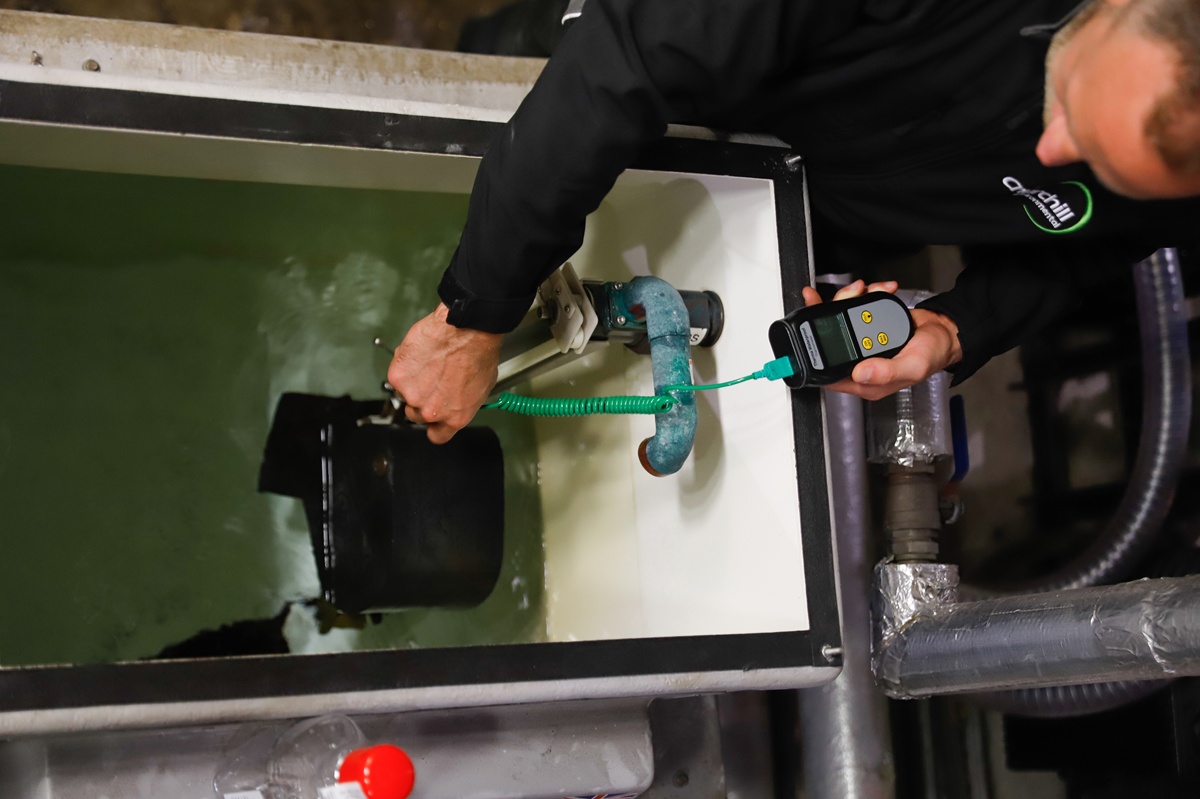
Picture: Image of a Churchill Environmental Services employee testing the water quality inside a large industrial tank. Credit: Churchill Environmental Services
Article written by Spencer Culley | Published 23 April 2026
Premier Technical Services Group Ltd (PTSG) has acquired Neptune Compliance Ltd, to strengthen its position in the UK water treatment and hygiene market and advance its...
Read Full ArticleAssurity Consulting, a UK independent workplace health, safety and environmental compliance consultancy, has launched a new software platform, marking a transformative...
Read Full ArticleChurchill Group has welcomed Principle, one of London’s established specialist commercial cleaning providers, into its group of businesses. With more than...
Read Full ArticlePatrick Turner, Director at WaterGuard warns the FM sector in the UK faces a quiet crisis in water hygiene. While buildings grow smarter and more connected, the...
Read Full ArticlePremier Technical Services Group (PTSG), a services and building compliance group, has appointed Craig Doig as Managing Director of its Water Treatment...
Read Full ArticleChurchill has appointed Ausra Baltrusaityte to its senior leadership team to lead service delivery for its rail and aviation customers. Ausra, who previously...
Read Full ArticleAmulet has won a 13-month contract to manage front-of-house security services at DLR depots. Amulet, which is part of Churchill Group, will work at the Beckton...
Read Full ArticleChurchill Group’s security and cleaning contract with the University of Suffolk has been extended for five years. Churchill has provided cleaning services at the...
Read Full ArticleChurchill has secured a three-year cleaning contract with flexible office space provider Harbour Exchange. Starting in October 2024, Churchill will provide...
Read Full ArticleUK manufacturer Cistermiser has been recognised at the Energy Saving Awards 2023 for its water-efficient control valve for mains-fed urinals. The company took home...
Read Full Article